



The federal government is carrying out a sweeping Trump branding push, placing President Donald Trump’s name, image or signature across a growing list of official buildings, programs, websites and government-issued items. The effort spans everything from a Washington peace institute and the Kennedy Center to paper currency, passports, prescription drug services and children’s savings accounts.
The scale of the move makes it one of the most visible presidential branding campaigns in modern U.S. government. According to the original report, Trump’s second-term administration has gone well beyond internal documents and standard communications, moving his name and likeness into public-facing federal symbols.
One of the most prominent changes came in December 2025, when the U.S. Institute of Peace headquarters in downtown Washington became the Donald J. Trump U.S. Institute of Peace.
The original agency was created by Congress through legislation in 1984, but the renaming was handled by the State Department. Secretary of State Marco Rubio defended the move in a social media post, saying Trump would be remembered as the “President of Peace.”
Roughly two weeks later, Trump’s name was also added to the John F. Kennedy Memorial Center for the Performing Arts. The president’s selected board voted to rename it the Donald J. Trump and John F. Kennedy Memorial Center for the Performing Arts.
That decision quickly became one of the most contested parts of the branding effort. Democrats and some members of the Kennedy family argue the change is illegal because the center was created as a living memorial to John F. Kennedy. Rep. Joyce Beatty, an ex officio board member, filed a lawsuit, and the case remains in litigation.
Trump-Class Battleships and the Gold Card Visa
The branding campaign has also reached the military. In December, then-Navy Secretary John Phelan announced “Trump-class” battleships during an event at Trump’s Mar-a-Lago estate in Florida.
Phelan described the ships, including one named the USS Defiant, as major new warships. Trump said he hoped they would never need to be used but claimed nothing like them had ever been built.
Another major initiative is the Trump gold card, a visa program unveiled in December. Foreign nationals can pay $1 million to obtain the card, which allows them to legally live and work in the United States after approval.
Trump called it the “green card on steroids” and said companies could buy the cards for students so they could remain in the country after graduation. As of late April, the original article says only one person had been approved for the card, citing reporting from The Associated Press.
Trump’s Name on Coins, Dollar Bills and Passports
Several of the most symbolic moves are tied to the United States’ 250th anniversary.
In March, a federal commission made up only of Trump-appointed members approved a 24-carat commemorative gold coin featuring Trump. The approved design shows Trump in the Oval Office on one side and a bald eagle on the other.
The coin still needs approval from the Treasury Department. The department has also announced a separate $1 coin featuring Trump as part of the anniversary celebration.
The Treasury Department also said in March that it would add Trump’s signature to future paper currency. According to the original article, this would be the first time a sitting U.S. president’s signature appears on U.S. paper money.
Normally, U.S. paper currency carries the signatures of the treasury secretary and the treasurer, not the president.
The State Department joined the anniversary-linked effort in April by announcing a limited series of U.S. passports featuring a large image of Trump on the inside cover. White House spokesperson Olivia Wales described the design as another way for Americans to take part in the country’s 250th birthday celebrations.
Park Passes, Banners and Government Websites
The Interior Department also placed Trump’s image on the front of its annual national park pass, alongside George Washington. The department cited the 250th anniversary as the reason for the design.
That move triggered a lawsuit from an environmental group. The group claims the department violated a 2004 law requiring the pass to feature a picture from the winner of an annual photo contest. The original winning image for the year showed Glacier National Park in Montana.
Trump’s image has also appeared on large banners hung outside the Justice Department, Agriculture Department and Labor Department. The Justice Department banner reads “Make America Safe Again.”
A DOJ spokesperson said the banner was meant to mark 250 years of the country and the department’s work under Trump’s direction.
The administration has also attached Trump’s name to federal websites. In April, Trump signed an executive order directing the Treasury Department to launch TrumpIRA.gov, a site designed to help American workers find and compare private-sector retirement savings accounts.
Trump Accounts and TrumpRx.gov Add Branding to Public Programs
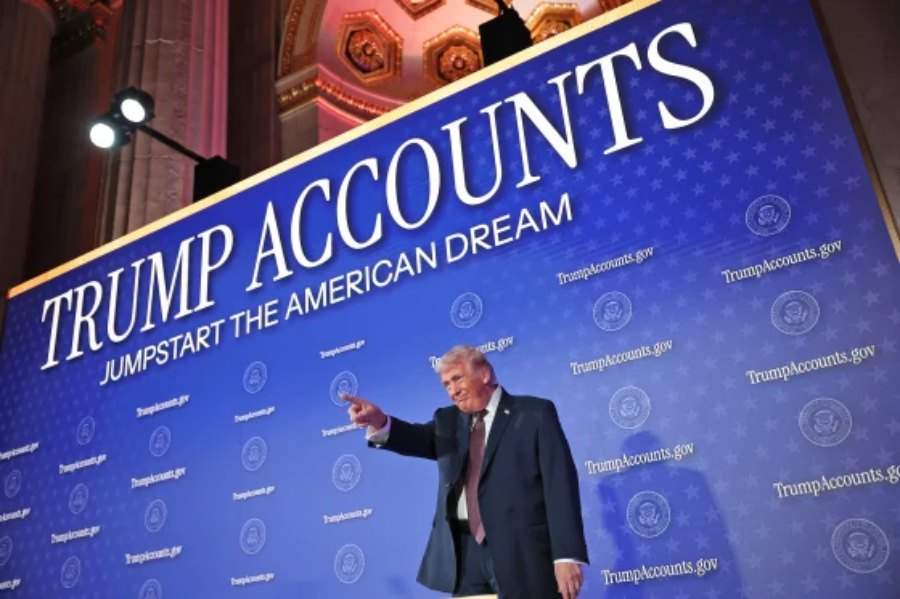
The administration is also launching Trump Accounts, new tax-advantaged investment accounts for children under 18.
The accounts were created under the “big, beautiful bill.” Babies born from Jan. 1, 2025, to Dec. 31, 2028, will receive $1,000 from the Treasury Department to start their accounts.
Trump referenced the program during his State of the Union speech in February, calling it “so special.”
Another public-facing program is TrumpRx.gov, a self-pay prescription drug website launched in February. The site offers coupons that people can take to pharmacies when filling prescriptions.
At the launch event, Trump said users would “save a fortune” and described the program as good for overall health care.
Why the Trump Branding Push Matters
The significance of this story lies in the breadth of the effort. The original article frames the campaign as a sharp departure from previous presidencies, including Trump’s first term, when the major branding controversy involved adding his name to Covid relief checks during an election year.
This second-term effort touches physical buildings, federal websites, military naming, travel documents, currency, public benefits and official banners. It has also produced legal fights and political objections, especially where existing names, laws or memorial purposes are involved.
For the public, the changes affect what people may see on government buildings, money, passports, park passes and websites. For federal agencies, the moves raise questions about how official institutions present presidential identity. For critics, the lawsuits show that not every branding decision is being accepted without challenge.
The Trump branding push has become a visible feature of the administration’s second term, extending across federal buildings, government programs, commemorative currency, passports, websites and public-facing symbols.
Some efforts have already taken effect. Others still need approval or face litigation. What is clear from the original report is that Trump’s name and image are being placed across the federal government on a scale the article describes as unmatched in modern U.S. presidential history.
