



What was presented to the world as a birthday getaway became, prosecutors argued, the culmination of months of obsession, planning, and rage.
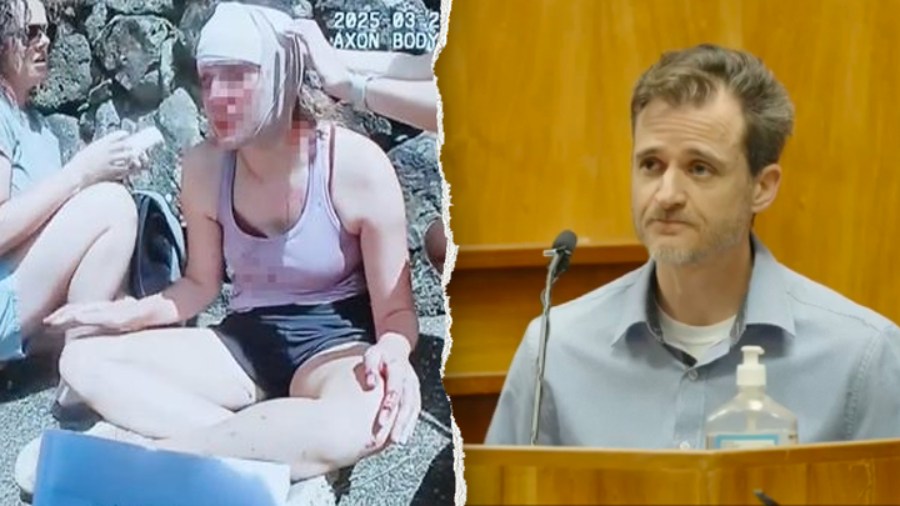
On March 24, 2025, Gerhardt Konig — a Hawaii anesthesiologist — and his wife Arielle traveled from Maui to Oahu. They set out on a hike along the Pali Puka Trail. By the time two passing hikers heard screaming and called 911, Arielle Konig was bloodied, clinging to consciousness, and her husband was gone.
On Tuesday, a jury delivered its verdict: Konig was convicted of attempted manslaughter based upon extreme mental or emotional disturbance. The case had laid bare a marriage fracturing under the weight of suspected infidelity — and the evidence prosecutors said showed a husband who had been quietly planning for the worst.
The prosecution’s case was built on two pillars: a digital trail and a phone call made in the immediate aftermath of the attack.
A forensic examiner testified that investigators recovered Reddit searches and posts from Konig’s personal laptop in the months before the incident. The threads carried titles that prosecutors called revealing: “Lying again,” “It’s over,” and “I did a horrible thing.”
Beyond the Reddit activity, authorities said Konig had purchased a voice-activated recorder and conducted targeted research into remote hiking locations — including the Pali Puka Trail specifically. His keyword searches included “kill,” “death,” “cliff,” and “fall.” A folder on his computer, prosecutors noted, was labeled “Divorce.”
Investigators also recovered a bloodstained rock, clothing, and bags allegedly containing medical supplies tied to Konig at the scene.
“They say that the digital trail reveals motive and planning,” prosecutors argued, contending the attack was not a spontaneous act of violence but a premeditated one — driven by a growing fixation on his wife’s alleged infidelity.
Arielle Konig’s Testimony
Arielle Konig took the stand and described the moment the hike turned violent in harrowing detail.
She told jurors that her husband grabbed her and attempted to force her toward the edge of the cliff. She said she threw herself to the ground and grabbed onto surrounding vegetation to prevent being pushed over. Then, she testified, he produced a syringe and told her to “hold still” — which she knocked away.
Moments later, she said, he picked up a rock and began striking her in the head.
“I just started screaming… he’s trying to kill me,” she testified.
Two hikers who heard her cries intervened and contacted emergency services. Body camera footage shown to jurors captured the aftermath — Arielle bloodied, disoriented, and struggling to remain conscious as bystanders worked to keep her stable.
“I would call it an attack versus a scuffle,” she told the jury, directly rejecting the defense’s characterization of the event.
The prosecution’s expert testimony also carried a pointed dimension: Konig’s former supervisor testified that as an anesthesiologist, Konig had professional knowledge of means to incapacitate or kill — adding context to the alleged syringe.
His Son’s Testimony — and a Damning Phone Call
Among the most consequential moments in the trial came from a witness no defense team wants to face: the defendant’s own son.
Emile Konig testified that his father called him shortly after the attack — and in that call, made admissions that prosecutors placed at the center of their case.
“He would not be making it back to Maui… and that he tried to kill her,” Emile testified, describing what his father told him. He said his father cited his wife’s alleged affair as the reason.
The call did not end there. Emile said his father then appeared on FaceTime with blood visible on his shirt and told him he intended to jump off a cliff before police could reach him.
“I’m going to go before the police catch me,” prosecutors said Konig told his son before ending the call.
Police testified that Konig fled the scene following the hikers’ intervention, triggering a manhunt that ended when he was spotted — bloodied shirt and all — and taken into custody after a struggle.
Konig’s Defense: Self-Defense and Marital Collapse
Konig himself took the stand and offered a sharply different account of what happened on the trail.
He acknowledged the violence but denied its intent. He told jurors he had discovered hidden messages between his wife and another man — a revelation he described as devastating and “the turning point in their marriage.”
On the trail, he claimed, his wife shoved him, grabbed him, and struck him with a rock first — and that he hit her only twice in response and in self-defense.
“I felt horrified about what I did to her,” Konig said from the stand. “I resorted to violence against my wife… the person I love the most.”
He denied attempting to push Arielle off the cliff and denied the syringe allegation entirely.
The defense sought to frame the incident as an “unplanned, unanticipated scuffle” — pointing to marital strain and expert testimony suggesting that Arielle’s injuries, while serious, were not life-threatening.
The jury did not fully accept either the prosecution’s attempted murder charge or the defense’s framing. Their verdict — attempted manslaughter under extreme emotional disturbance — reflected a finding that violence occurred and that Konig bore legal responsibility, but that mitigating emotional circumstances played a role.
The conviction of Gerhardt Konig brings a legal conclusion to a case that began on a remote Oahu hiking trail and played out in courtroom testimony involving Reddit threads, a bloodied rock, a syringe, and a phone call a father made to his own son in the immediate aftermath of the alleged attack. For Arielle Konig, the verdict validates what she described under oath: not a scuffle, but an attack. For the jury, the answer to what happened on that cliffside lay somewhere between premeditated murder and a marriage’s violent, tragic unraveling. Sentencing will determine what consequences Gerhardt Konig ultimately faces — and how the legal system weighs the line between jealousy, grief, and the violence they can produce.
