



A Utah jury has delivered its judgment: Kouri Richins murdered her husband.
After three weeks of testimony spanning forensic toxicology, explosive text messages, and a housekeeper-turned-drug-witness, jurors found the 35-year-old Kamas, Utah mother of three guilty on every count filed against her — including aggravated murder — in the March 2022 fentanyl poisoning death of Eric Richins. The verdict arrived Sunday, March 16, 2026, closing a case that had gripped the country since it first emerged that the accused killer had written a children’s grief book about losing her husband.
Richins now faces the very real prospect of spending the remainder of her life behind bars. Her sentencing hearing is set for May 13, 2026, at 9:30 a.m. MST.
From the outset, Summit County prosecutors framed this case not as a domestic tragedy but as a deliberate, financially motivated murder. Their argument was straightforward: Richins killed Eric Richins to get his money.
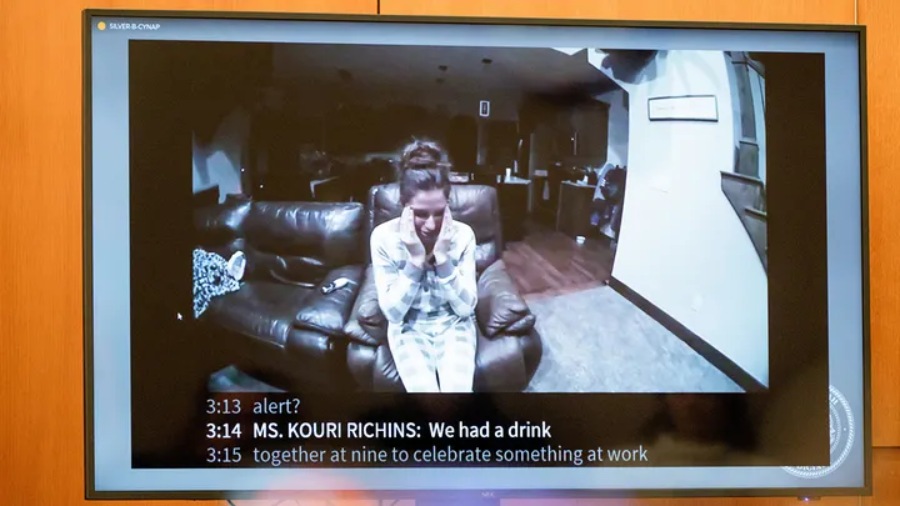
According to the prosecution, the fatal night unfolded at the couple’s home, where Richins allegedly slipped illicit fentanyl into a Moscow mule while the two were celebrating together. A medical examiner’s findings were stark — Eric Richins had more than five times the lethal dose of fentanyl in his system at the time of death. His body also contained 16,000 ng/ml of quetiapine, an antipsychotic sometimes prescribed as a sleep aid, according to charging documents.
But prosecutors told jurors the murder did not begin that night.
Valentine’s Day: The First Alleged Poisoning Attempt
Weeks before Eric Richins died, on Valentine’s Day 2022, prosecutors alleged Kouri made her first move. According to court records, she laced his favorite sandwich with fentanyl. He survived — but barely.
Eric Richins broke out in hives and struggled to breathe after eating the sandwich. He reached for his son’s EpiPen, took Benadryl, and eventually fell asleep for several hours, unaware, prosecutors contended, that his wife had just tried to kill him.
The survival only delayed what prosecutors called an inevitable second attempt.
The financial picture painted by prosecutors was staggering.
A forensic accountant testified that Richins was carrying $7.5 million in debt before her husband’s death. Her bank accounts were repeatedly overdrawn. She owed approximately $80,000 per month in expenses. At one point, she was simultaneously paying four separate payday lenders roughly $2,100 per day.
The same day Eric Richins died, she closed on a $2.9 million mansion — a purchase his family said he never approved.
Prosecutors argued Richins had also quietly taken out multiple life insurance policies totaling nearly $2 million on her husband and then changed the beneficiary designation to herself — without his knowledge or authorization. Eric Richins eventually discovered the change and switched the beneficiary back to his business partner.
Within three months of his death, prosecutors said, Richins had spent $1.35 million of the life insurance proceeds.
One of the trial’s most gripping witnesses was Carmen Lauber, the Richins family housekeeper, who told jurors she helped procure drugs for Kouri Richins.
Lauber testified that in early 2022, Richins initially asked for pain pills, claiming an “investor” needed them. The requests escalated. Richins then reportedly asked for what she described as the “Michael Jackson stuff” — a phrase prosecutors characterized as a reference to powerful controlled substances. Lauber said she left pills at a location for Richins and later received $1,000 in cash to purchase more.
Prosecutors argued that chain of drug acquisition ultimately led to the illicit fentanyl that killed Eric Richins.
A Marriage in Collapse — and a Husband Who Feared for His Life
The testimony also revealed a marriage deteriorating long before Eric Richins’ death.
Jurors heard from Eric Richins’ sister, who testified he had expressed fears that his wife might be trying to kill him in the period before he died. He had also consulted a divorce attorney and taken steps to shift assets in his estate plan away from Kouri and toward their children.
Text messages shown to jurors included a message from Richins’ former boyfriend, who wrote that it was “draining to love” her. Another message, allegedly sent by Richins herself, stated: “I am in love with a man that’s not my husband.”
A family friend testified Richins had said she felt “trapped” in the marriage and worried that the couple’s prenuptial agreement would leave her financially disadvantaged in a divorce.
Prosecutors also presented a message Richins allegedly sent following Eric’s death: “They will not take from me what is mine.”
Another message, previously sent to a friend, read: “If I die, Eric did it.”
A forensic analyst further testified that hundreds of text messages were deleted from one of Richins’ phones between January and mid-March 2022.
What transformed this already disturbing case into a national phenomenon was the revelation that, after her husband’s death, Kouri Richins had authored a children’s book titled Are You With Me? — a work she described as a tool to help her three young sons process the grief of losing their father.
The juxtaposition — a grieving mother turned published author, later charged with being the architect of that very grief — made headlines across the country and sparked a broader conversation about domestic violence, financial abuse, and the masks people wear.
Richins’ attorneys — Wendy Lewis, Kathy Nester, and Alex Ramos — mounted an aggressive defense throughout the three-week trial.
They challenged investigators over delayed reports, missing notes, and what they described as lapses in evidence handling. A state toxicologist acknowledged under cross-examination that Eric Richins could theoretically have consumed fentanyl before drinking the Moscow mule — a point the defense used to question the prosecution’s central narrative.
Defense lawyers also scrutinized the chain of custody for evidence collected from the home, including phones, THC gummies, and items documented during a 3D scan of the residence.
In a statement after closing arguments, the defense team maintained that “accusations are not enough” and that the law demands proof beyond a reasonable doubt — a standard they argued prosecutors had not met.
The jury disagreed.
Prosecutor’s Final Word: “A Black Widow”
During closing arguments, Summit County Chief Prosecutor Brad Bloodworth offered jurors a final, pointed image of who he believed Kouri Richins to be.
He replayed the opening minute of the 911 call made the morning Eric Richins was found dead and told jurors the sound they heard was not that of a devastated wife.
“It was not the sound of a wife becoming a widow,” Bloodworth said. “It was the sound of a wife becoming a black widow.”
He argued Richins craved the image of a perfect, affluent life — but wanted it funded by her husband’s death rather than earned alongside him. “She wanted the perfect life. Or, at least, the appearance of a perfect life.”
With the guilty verdict now on record, attention turns to sentencing. Richins faces a life sentence when she appears before the court on May 13, 2026. Her attorneys, who said she has maintained her innocence since the beginning of the case, expressed hope she would one day return home to her three sons.
That outcome now appears extraordinarily unlikely.
