



When most people think about the infrastructure that holds the modern world together, they think about power grids, satellites, and supply chains. They rarely think about the miles of fiber-optic cable running along the ocean floor — the actual physical backbone through which virtually all global internet traffic and financial transactions flow.
Andrew Badger thinks about it constantly. And what he sees concerns him deeply.
“America depends on the fragile nervous system of subsea cables for modern life,” Badger, a former Pentagon official and current chief strategy officer at defense tech startup Coalition Systems, told Fox News Digital. “U.S. adversaries seek to turn the bottom of the ocean into a battlefield.”
The Scale of What’s at Stake
The numbers involved make the vulnerability impossible to dismiss on grounds of abstraction.
Undersea cables carry 99% of the world’s internet traffic. They also facilitate up to $10 trillion in daily financial transactions — a figure that encompasses everything from global banking transfers to energy market settlements to military logistics payments.
A coordinated attack on that infrastructure would not simply cause inconvenience. According to Badger, it would cause cascading, potentially catastrophic disruption.
“A coordinated strike on American undersea infrastructure could fundamentally disrupt our way of life — the internet, banking, energy markets and military communications all run through these cables. The dollar cost is almost incalculable, and the real damage would be the chaos and political instability that would follow,” he said.
“Cables give Beijing and Moscow the ability to inflict devastating economic chaos almost at will. This gives both nations tremendous strategic leverage over the U.S.”
China’s Capabilities Are Advancing
The concern is not theoretical. In April 2026, China’s Ministry of Natural Resources confirmed the successful testing of an advanced “electro-hydrostatic actuator” — a device capable of severing armored submarine cables at depths of up to 3,500 meters. The confirmation arrived without fanfare, but the implications were significant: China has now publicly demonstrated a tool purpose-built for cutting the cables that underpin the global economy.
Taiwan — already one of the world’s most significant flashpoints in U.S.-China relations — has reported approximately 30 subsea cable incidents in recent years. One such incident, allegedly involving Chinese vessels, severed cables and disrupted communications for months.
Similar suspicious disruptions have been documented in European waters, raising concerns among NATO allies about coordinated “gray-zone” operations — actions calculated to probe Western responses while remaining just below the threshold that would constitute an open act of war.
“This is hybrid warfare in its purest form, designed to weaken the adversary below the threshold of declared war,” Badger said, noting that using anchors dragging across the seabed provides a ready-made source of plausible deniability.
The Asymmetric Gap
The core of Badger’s warning is not simply that the threat exists — it is that the defensive response has not kept pace with the offensive capability.
“The asymmetric threat — China and Russia are devoting far more resources to attacking undersea infrastructure than the U.S. or its allies are to defending it. They’ve identified one of our greatest vulnerabilities, and we haven’t caught up,” he said.
That imbalance creates a window of strategic leverage that both Beijing and Moscow understand and are actively exploiting. Incidents that look like accidents — a ship dragging an anchor, a cable severed by what appears to be routine commercial traffic — may in practice be deliberate probes designed to map Western response times and identify the most consequential targets.
Anniki Mikelsaar of the Oxford Internet Institute offered a note of contextual balance, observing that “not all recent cable damage incidents can be attributed to foreign adversaries” and that the International Cable Protection Committee estimates 150 to 200 cable breaks occur globally each year, the majority from accidents.
But the pattern of incidents near Taiwan and in European waters has generated enough concern among intelligence agencies and defense officials that the accidental explanation is no longer being taken as sufficient.
The Taiwan Dimension
Badger’s most pointed warning involves the specific role undersea cables could play in a potential Taiwan conflict — not as a tool of military victory, but as a weapon targeting American political will.
“Beijing could simultaneously target cables landing in the U.S., not to win militarily, but with the goal of breaking the American public’s will to intervene in Taiwan,” he said.
The logic is strategic rather than purely destructive: if a conflict over Taiwan coincided with internet outages, banking disruptions, and financial market chaos on the American mainland, the domestic political pressure to disengage could become overwhelming — regardless of treaty obligations or formal policy commitments.
China claims Taiwan as its own territory. The United States — Taiwan’s most significant unofficial ally — is legally required under existing law to help the island defend itself. The Taiwan Strait is also a critical transit route for the semiconductor supply chains that are foundational to the global AI industry.
Congress Responds
The legislative branch is beginning to catch up with the threat environment. In April, Senate Republican Whip John Barrasso, R-Wyo. and Sen. Jeanne Shaheen, D-N.H. introduced the bipartisan Strategic Subsea Cables Act of 2026 — legislation designed to strengthen the security and resilience of critical undersea infrastructure.
“Undersea cables are important for a variety of reasons. They carry 99% of the world’s internet traffic. They also support $10 trillion in financial transactions each and every day,” Barrasso said in a statement.
The bill’s bipartisan nature signals that the threat is being taken seriously across party lines — even as the broader U.S.-China relationship enters a new phase of diplomatic engagement.
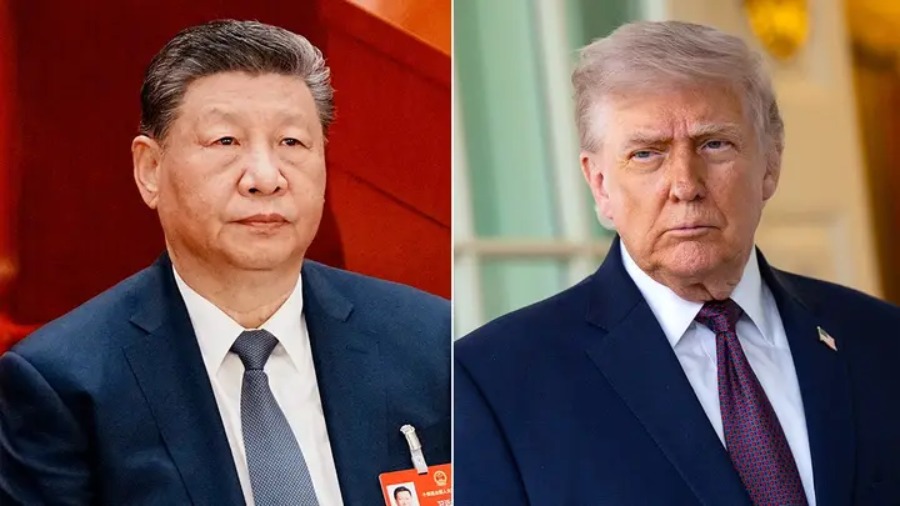
Badger’s warnings land at a particularly consequential diplomatic moment. President Trump is preparing to meet with Chinese President Xi Jinping in Beijing for talks expected to address trade, artificial intelligence, and Taiwan — three issues that are individually significant and collectively interconnected with the undersea cable threat in ways that will likely shape the substance of those conversations.
Whether undersea infrastructure security makes it onto the formal agenda of the Trump-Xi summit is unclear. What is clear is that the strategic context surrounding those talks includes a capability that China has now publicly confirmed — and that American officials are increasingly vocal about not having adequately prepared to defend against.
The $10 trillion daily flowing through undersea cables is not a number most people encounter in their daily lives — and that invisibility is precisely what makes the infrastructure so strategically attractive as a target. Badger’s warning is not that an attack is imminent. It is that the capability exists, the gap in defensive investment is real, and the political leverage that control over those cables confers on China and Russia is already being exercised in the gray zone between peace and war. The Strategic Subsea Cables Act is a start. Whether it is enough — and whether it arrives before the next incident proves to be something more than an accident — is the question that the Trump-Xi summit and the months that follow will begin to answer.
