



The White House launched a forceful offensive Friday against CNN after the network reported that President Donald Trump’s national security team had failed to fully prepare for the possibility that Iran might shut down the Strait of Hormuz — one of the world’s most strategically vital waterways — in the wake of U.S. military strikes.
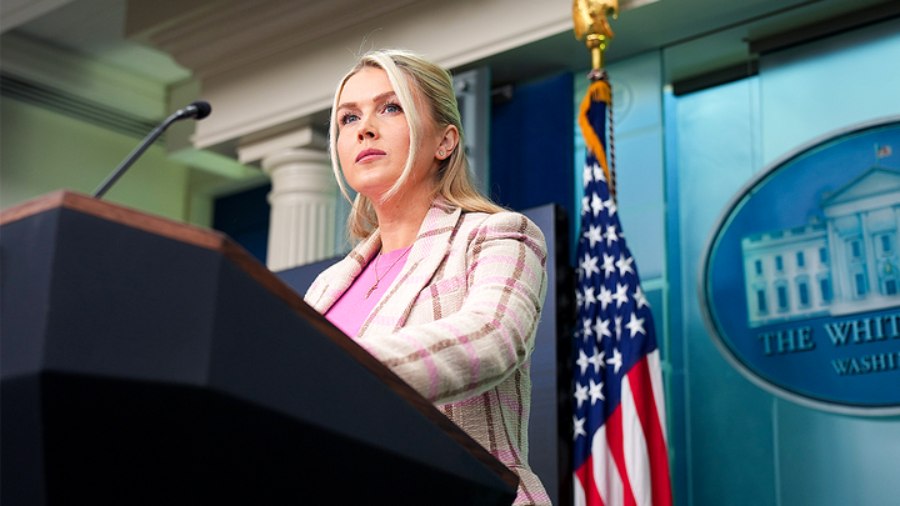
Press Secretary Karoline Leavitt didn’t mince words. Taking to X, she declared the CNN story “100% FAKE NEWS” and accused the outlet of building its report on anonymous sourcing with no factual foundation.
CNN’s Thursday report alleged that Trump’s national security team “failed to fully account for the potential consequences” of what unnamed officials described as a worst-case scenario now confronting the administration — specifically, Iran retaliating by blocking the Strait of Hormuz.
The report leaned heavily on sources described only as “familiar with the matter,” offering no named officials to substantiate the claims.
That reliance on anonymous sourcing drew sharp condemnation from the administration and its allies on Capitol Hill.
‘Preposterous’ — The White House Responds
Leavitt pushed back point by point. She argued that the Pentagon has spent decades preparing contingency plans for a potential Iranian closure of the strait — and that this scenario was explicitly factored into the administration’s strategy before Operation Epic Fury was launched.
“The idea that chairman Cain and Secretary Hegseth weren’t prepared for this possibility is PREPOSTEROUS,” she wrote.
She went further, explaining that one of the operation’s stated goals — dismantling Iran’s naval power, missile systems, and drone production capabilities — was itself designed to neutralize Iran’s capacity to threaten the strait in the first place.
“The President was fully briefed on it,” Leavitt stated, adding that the operation aimed “to annihilate the terrorist Iranian regime’s navy, missiles, drone production infrastructure, and other threat capabilities.”
The stakes behind this dispute are enormous. The Strait of Hormuz, a narrow chokepoint between Iran and the Arabian Peninsula, serves as the passage for roughly one-fifth of the world’s oil shipments. Any disruption there would send shockwaves through global energy markets.
Iran has long used the threat of closing the strait as geopolitical leverage. It is precisely this dynamic — well-documented over decades — that critics say makes CNN’s claim of administration unpreparedness implausible.
Secretary of War Pete Hegseth amplified the White House’s pushback during a Friday appearance at the Pentagon, calling the CNN report “more fake news” and “patently ridiculous.”
“For decades, Iran has threatened shipping in the Strait of Hormuz. This is always what they do, hold the strait hostage,” Hegseth said. “CNN doesn’t think we thought of that.”
On Capitol Hill, Sen. Tom Cotton, chairman of the Senate Intelligence Committee, took direct aim at CNN’s sources rather than the outlet itself.
“As chairman of the Intelligence Committee, let me make clear: whoever leaked this lied,” Cotton wrote on X. “CNN should do some fact-checking.”
CNN Clarifies — But Holds Its Ground
Facing mounting criticism, CNN issued an update to the story Friday. The clarification acknowledged that top Trump administration officials had briefed lawmakers on long-standing military plans to handle a major Strait of Hormuz disruption. However, CNN maintained that multiple sources said the briefing contained “no indication there were any near-term solutions.”
CNN told Fox News Digital it stands by its reporting. CNN Chairman and CEO Mark Thompson echoed that stance on X, writing simply: “We stand by our journalism.” Friday’s confrontation was not an isolated incident. The White House has been locked in a running battle with major news organizations over coverage of the ongoing Iran conflict.
On Thursday, Leavitt called on ABC News to retract a story claiming the FBI had officially warned that Iran might attempt drone attacks on California. She called the report “false information to intentionally alarm the American people,” stating it originated from “one email sent to local law enforcement about a single, unverified tip.”
ABC News subsequently updated its report with an editor’s note, acknowledging that the FBI’s alert to California authorities included a statement that the information was unverified. The clash between the White House and CNN over Iran Strait of Hormuz preparedness reflects a deepening mistrust between the Trump administration and major media outlets during a period of active military conflict. With CNN standing by its reporting and the administration calling it fabricated, the dispute is unlikely to fade quickly — particularly as the situation in the strait continues to evolve.
Whether the administration’s planning was truly airtight, or whether gaps existed as CNN’s sources claim, may only become clear as the conflict unfolds.
