



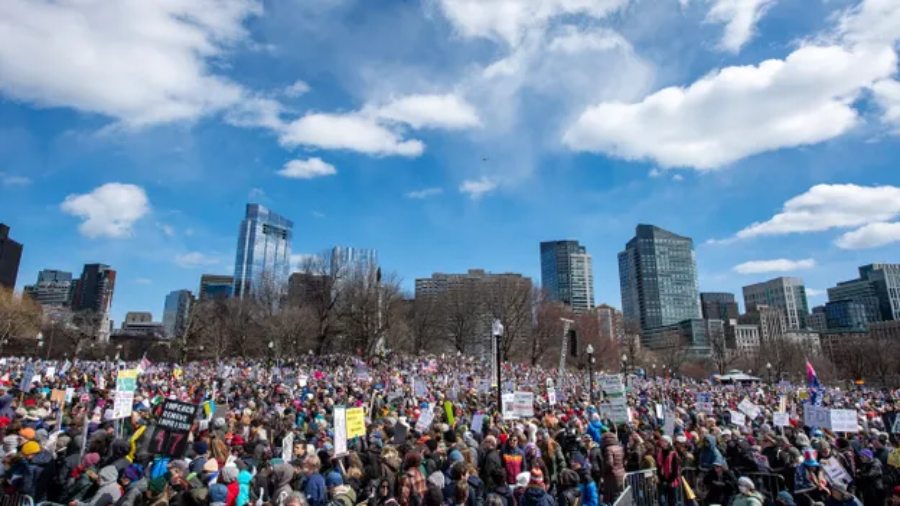
What began as a decentralized protest movement burst into one of the largest single-day demonstrations in recent American history on Saturday, March 28, 2026.
The “No Kings” movement — which first emerged during “No Kings Day” in June 2025 — staged more than 3,300 events across all 50 states, with its flagship rally anchored in St. Paul, Minnesota. Organizers told Fox News Digital that at least 8 million people participated nationwide.
By nightfall, however, the story had shifted. What unfolded in several cities went well beyond peaceful dissent.
The demonstrations targeted multiple fronts of the Trump administration’s agenda simultaneously — most prominently, the ongoing U.S. military campaign against Iran, known as Operation Epic Fury, as well as aggressive immigration enforcement across the country.
On its official website, the “No Kings” movement accused the administration of “spending billions of our tax dollars on missile strikes abroad all while driving up the cost of living and handing out massive giveaways to billionaire allies.”
The movement provided organizers with a detailed “March 28 Toolkit” — a structured document covering how to recruit speakers, assign roles, register events, and use official branded media materials. It also outlined how to handle event logistics and, notably, how to navigate around permitting and insurance requirements.
As rallies wound down in several cities, a more volatile scene took shape.
In Portland, Oregon, masked agitators targeted the local Immigration and Customs Enforcement (ICE) facility hours after more than a dozen “No Kings” events concluded across the city. Video footage showed individuals tackling Department of Homeland Security (DHS) officers to the ground. Objects were hurled at law enforcement as agitators shouted expletives. Hate speech, including the word “nazis,” was spray-painted on the building’s exterior.
The Portland Police Bureau issued an urgent public warning on X, stating: “Do not breach the doors or enter the ICE facility or property.” Officials warned that crowd control measures — including impact munitions — could be deployed if necessary.
In Los Angeles, the situation escalated near the downtown DHS building. Federal authorities deployed tear gas after agitators — warned repeatedly — continued throwing large concrete blocks, bottles, and other objects over the facility’s fence and attempted to pull down its gate. The Los Angeles Police Department declared a “tactical alert” for the city, and a dispersal order was issued at approximately 5:30 p.m. local time, giving those present 15 minutes to vacate the area before arrests commenced. Multiple people were subsequently taken into custody.
In Denver, a peaceful protest turned confrontational when a small group blocked a road where officers were staged. Authorities declared an unlawful assembly, and after repeated dispersal orders were ignored, deployed smoke grenades to break up the crowd. When a smoke canister was allegedly thrown back at officers, police responded with pepper balls. A total of nine people were arrested. The crowd had “decreased significantly” by the time officials issued their latest update.
In Dallas, at least one protester was arrested after clashes broke out between protesters and counter-protesters in the downtown area.
Who Was Behind It?
A Fox News Digital investigation revealed that the “No Kings” movement was far more organized — and far better funded — than its decentralized branding suggested.
Approximately 500 organizations with an estimated combined annual revenue of $3 billion were found to be involved in coordinating the nationwide effort. According to a permit obtained for the flagship St. Paul march, Indivisible — a national Democratic political advocacy organization funded in part by billionaire George Soros — served as the lead coordinator.
Fox News Digital also identified involvement from a network of radical socialist and communist organizations connected to Neville Roy Singham, an American tech entrepreneur and self-described communist based in China.
Among the participants, CodePink circulated graphics linking the protests to anti-imperialist messaging, calling members to rallies in cities including Washington, D.C., Los Angeles, Chicago, San Francisco, and New York — and connecting the demonstrations to opposition against U.S. policy toward Iran, Cuba, Venezuela, and Palestine. In recent weeks, the group has voiced support for Venezuelan President Nicolás Maduro, the late Iranian Ayatollah Ali Khomeini, and Chinese President Xi Jinping.
Prominent Voices Take the Stage
Several high-profile figures used the rallies as a platform for pointed political messaging.
Robert De Niro delivered a combative speech at the New York City rally, calling President Trump “an existential threat to our freedoms and security” who “must be stopped now.” He accused the administration of engaging in unnecessary wars, stripping healthcare access from vulnerable citizens, and deploying “government mass thugs” against civilians. He closed with a direct appeal: “We’re going from the streets to the ballot box.”
In Boston, Sen. Elizabeth Warren, D-Mass., told a massive crowd at Boston Common — where organizers had anticipated more than 100,000 attendees — that Trump had broken his promise to lower costs, instead delivering “tariffs, wars and a billionaire tax” that raised prices on groceries, healthcare, gasoline, and housing. She closed by asking the crowd directly: “Will you fight back?”
In Minneapolis, Minnesota Gov. Tim Walz used the occasion to lash out at the Trump administration, calling the president a “wannabe dictator” and an “orange clown.” He embraced the accusation of radicalism head-on. “You’re damn right we’ve been radicalized,” Walz said, arguing his supporters had been “radicalized by compassion” and “decency.” He also pledged solidarity with Somali Minnesotans, vowing their communities would outlast the current administration.
Walz blamed the White House for the deaths of Renee Good and Alex Pretti, two Minnesota residents fatally shot in January during separate confrontations with federal immigration enforcement agents.
Not everyone who showed up on Saturday was there to oppose the Trump administration.
At the New York City rally, counter-protesters made their presence known, defending the president’s democratic mandate.
“He was elected by the peers of the United States, by the citizens who used their electoral vote, and he won,” said a counter-protester named Michael. “We’re here to support our president.”
Another Trump supporter, Ronan, framed the counter-demonstration as a defense of constitutional principles. “The last time I checked, we don’t have kings. That’s the United Kingdom,” he said. “I’m here to express my freedom of expression and speech.”
In West Palm Beach, Florida — where President Trump was spending the weekend at Mar-a-Lago — protesters and counter-protesters clashed verbally, with insults exchanged on both sides. Video captured protesters chasing a man wearing a MAGA hat through the crowd. At one point, a counter-protester carrying a “Faith Over Fear” flag led his group in a rendition of “God Bless the USA.”
On the Fringes: Activist Agendas Beyond the Rally
Not all messaging at the rallies was straightforwardly political.
A representative for the Sunrise Movement — a youth-led organization originally founded around climate justice — told Fox News Digital at the New York City rally that the group has pivoted toward targeting ICE and opposing what it calls the “Trump regime.” The representative, named Cameron, claimed that coordinated noise protests outside Hilton hotels housing ICE personnel have already cost the chain at least $18 million and caused at least four hotels to end their agreements with the agency. He also warned of “a lot more direct action coming” and revealed the group is currently conducting training sessions for a planned general strike.
The “No Kings” protests of March 28, 2026, marked a significant moment in organized opposition to the Trump administration — both in scale and in complexity. With 8 million claimed participants, 3,300+ events, and a funding network spanning hundreds of organizations, the movement has clearly moved well beyond grassroots spontaneity. But the violence that erupted in Portland, Los Angeles, and Denver threatens to overshadow the broader message — and will likely intensify the national debate over the boundaries between protest and disorder. The days ahead will reveal whether the movement can channel its energy into the ballot box, as its speakers urged, or whether the more volatile elements will come to define its legacy.
