



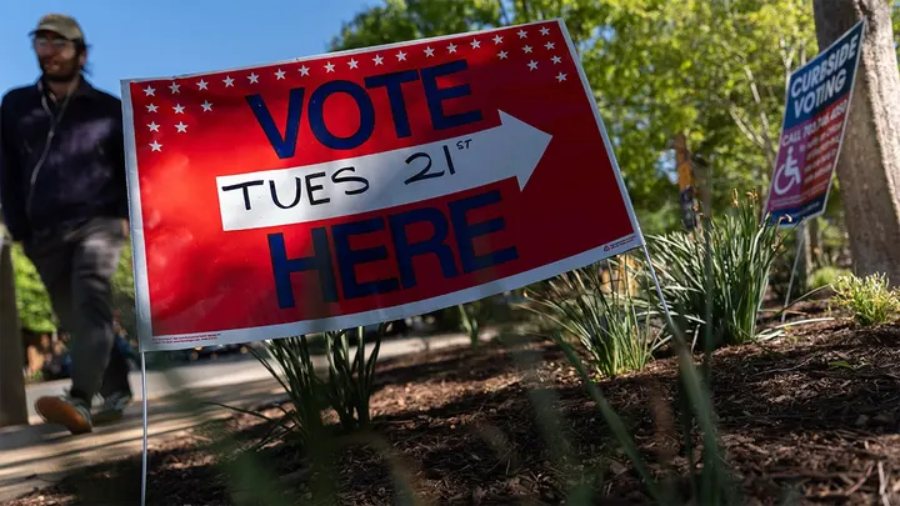
Virginia voters approved a redistricting referendum on Tuesday evening. By Wednesday, a circuit court judge had ruled it unconstitutional.
The speed of the legal reversal underscored just how contested the redistricting battle in Virginia has become — and how far from settled the question of who will ultimately draw the state’s congressional maps remains.
Tazewell Circuit Court Judge Jack Hurley issued the ruling on Wednesday, one day after the Democrat-backed referendum passed at the ballot box. In his decision, Hurley declared that all votes cast for or against the proposed redistricting amendment were unconstitutional, citing procedural requirements embedded in Virginia’s constitution that the referendum process had failed to satisfy.
The ruling included an injunction blocking certification of the election result. Hurley also denied a motion to stay the injunction pending appeal — meaning the block takes effect immediately while the legal fight moves to higher courts.
The Constitutional Argument
The legal challenge at the center of Judge Hurley’s ruling turns on a specific and consequential procedural point about how Virginia’s constitution requires amendments to be passed.
Former Republican Virginia Attorney General Ken Cuccinelli — who now heads the American Principles Project Election Transparency Initiative and has been tracking the legal challenges closely — explained the argument in an interview with CNN conservative commentator Scott Jennings on Wednesday.
Under Virginia’s constitutional amendment process, the General Assembly must pass a proposed amendment, then allow an intervening election to occur — in which a new House of Delegates is elected — before the same amendment is passed again by that new legislature. The intent is to ensure that voters have the opportunity to weigh in on the composition of the body that makes the final decision.
The problem, Cuccinelli argued, is one of timing.
“The General Assembly passed the amendment for the first time — called first passage, very creative — on Halloween,” he said, referring to October 31, 2025. “Well, these same Democrats, five years ago, gave us a 45-day election. So, voting began September 19 of 2025. Over a million people had already voted before first passage, and they want to treat that election as the intervening election. They’re going to have a very difficult time with that.”
In other words: the election that Democrats are counting as the constitutionally required intervening election had already begun — with more than one million ballots cast — before the General Assembly even completed the first passage of the amendment. Whether that sequence satisfies Virginia’s constitutional requirements is now a question for the Virginia Supreme Court to resolve.
Cuccinelli said there are four separate constitutional challenges to the referendum currently making their way through the Virginia court system — three of which challenge the amendment process itself, with the fourth targeting a different aspect of the referendum. He said he expects the courts to move quickly and anticipates a final ruling by May.
Democrats Respond: ‘Activist Judge’
Virginia Attorney General Jay Jones — a Democrat who defeated Republican incumbent Jason Miyares in November — announced his office’s response almost immediately after news of the ruling broke.
“Virginia voters have spoken, and an activist judge should not have veto power over the People’s vote,” Jones said. “We look forward to defending the outcome of last night’s election in court.”
His office confirmed it would immediately file an appeal — a move that was expected given the high political stakes and the legal challenges that had been building around the referendum for months.
Democrat strategist Adam Parkhomenko echoed the attorney general’s framing on X, characterizing the ruling as anti-democratic overreach.
“Virginia voters spoke. MAGA lost. And now a rogue Republican judge is trying to override the will of the people because they didn’t like the outcome. That’s not democracy. That’s desperation,” Parkhomenko wrote.
He added that he has “full confidence a higher court will overturn this nonsense quickly, and the will of Virginia voters will prevail.”
What Is at Stake
The legal outcome of these challenges carries consequences that extend well beyond Virginia’s borders.
If the redistricting maps drawn by the Democratic-controlled General Assembly are ultimately upheld, Virginia’s congressional delegation could shift from its current 6-5 Democratic edge to a potential 10-1 Democratic advantage — a swing of four seats in a chamber where House Republicans currently hold a razor-thin majority.
Four additional Democratic House seats from Virginia alone could meaningfully alter the balance of power in Congress ahead of the 2026 midterms — which is precisely why both parties have invested so heavily in this fight, and why the legal resolution will be watched nationally.
The case will now move through Virginia’s appeals process toward the Virginia Supreme Court — the same court that previously allowed the referendum to proceed after an earlier lower court had blocked it.
Cuccinelli said he expects the courts to act with urgency given the electoral timeline. With the 2026 midterms approaching, the window for drawing and implementing new congressional maps is finite — and every week spent in litigation narrows the available time.
The Virginia Supreme Court’s ultimate ruling will determine whether the referendum is reinstated, the maps are redrawn, or the redistricting process returns to the nonpartisan commission that held the authority before the referendum was approved.
In the span of 24 hours, Virginia’s redistricting battle went from a Democratic electoral victory to a Republican legal victory — and the final outcome remains genuinely uncertain. Judge Hurley’s ruling does not end the fight. It escalates it to a higher level of the judiciary, where the Virginia Supreme Court will ultimately decide whether the procedural sequence Democrats used to pass the redistricting amendment satisfies the constitutional requirements Virginia’s own charter demands. The answer to that question will shape congressional representation — and potentially the balance of power in the U.S. House of Representatives — for years to come.
