



Federal authorities stopped Tianrui Liang at John F. Kennedy International Airport on April 7 as he was preparing to board an international flight out of the United States. He was taken into custody just days after a warrant had been issued in Nebraska — the state where prosecutors say the 21-year-old had been photographing some of the American military’s most sensitive aircraft without authorization.
Liang, a Chinese national enrolled at Glasgow University in Scotland, now faces federal charges for allegedly violating the law that prohibits photographing United States military installations without the express approval of a base commander.
The case was filed in the Eastern District of New York.
The Base at the Center of the Case
The military installation in question is not a routine airfield. Offutt Air Force Base in Nebraska is home to U.S. Strategic Command — one of the Pentagon’s most sensitive and consequential commands, responsible for the nation’s nuclear deterrence and global strike capabilities.
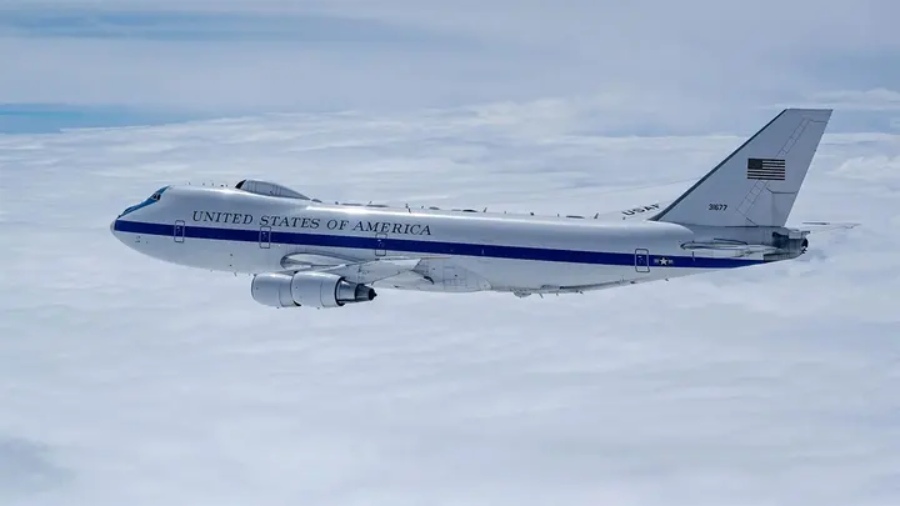
The aircraft based at Offutt reflect that significance. Among them is the RC-135 — a long-range reconnaissance platform used for intelligence collection — and, more notably, the E-4B “Nightwatch.” The E-4B is a militarized variant of the Boeing 747-200 capable of long-range, high-altitude operations and in-flight refueling. It is widely referred to as the military’s “doomsday plane” — the airborne command and control aircraft designed to keep senior national leadership operational in the event of a catastrophic attack on the United States.
Both of those aircraft, authorities say, were among those Liang photographed.
How He Was Caught
The investigation began when a witness reported seeing a man near the base holding a camera equipped with a telescopic lens — a detail that alerted authorities and triggered an FBI inquiry.
According to an FBI affidavit, when investigators eventually questioned Liang, he acknowledged photographing aircraft at Offutt — confirming he had captured images of both the RC-135 and the E-4B. He told agents he had used a “planespotter” website to identify suitable photography vantage points outside the installation.
His stated explanation for the images: they were for his “personal collection.”
The affidavit cuts through that justification directly.
“He knew it was illegal to take pictures of the planes on the ground,” the document states.
A subsequent examination of his camera revealed “numerous photographs of planes located on the OAFB flightline” — aircraft parked on the base, captured from positions outside its perimeter.
The alleged photography at Offutt was not, investigators say, where Liang intended to stop.
Authorities allege he had also been planning to travel to Oklahoma, where he intended to photograph additional aircraft at Tinker Air Force Base — including, again, the E-4B. That plan was interrupted by his arrest at JFK before he could board his departing flight.
Liang had entered the United States through Canada before making his way to Nebraska and the vicinity of Offutt.
What the Charges Do — and Do Not — Allege
It is worth noting precisely what federal prosecutors have and have not claimed about Liang’s motivations and affiliations.
The charges relate to the unauthorized photography of a military installation — a federal violation that does not require prosecutors to prove espionage or a connection to a foreign intelligence service. And critically, the affidavit does not allege that Liang was operating on behalf of the Chinese government or any other foreign government entity.
Whether investigators develop additional evidence — or whether the case remains limited to the unauthorized photography charge — will be closely watched given the sensitive nature of the aircraft involved and the broader context of heightened concerns about Chinese nationals accessing or observing U.S. military assets.
A Pattern of Concern
The case arrives amid a stream of incidents involving foreign nationals — many of them Chinese citizens — caught near or on U.S. military installations in recent years. From drone overflights at Vandenberg Space Force Base to arrests involving surveillance of Navy personnel and bases, federal authorities have grown increasingly vocal about the national security implications of these incidents.
Offutt Air Force Base, given its role as the home of U.S. Strategic Command, represents a particularly sensitive target. The mere presence of someone photographing its flight line assets — regardless of whether a foreign government connection is ultimately established — is the kind of incident that draws immediate federal attention.
The arrest of Tianrui Liang at JFK Airport adds another case to a growing list of incidents raising questions about the security of U.S. military installations against observation by foreign nationals. Whether his stated motivation — a personal photo collection assembled with the help of aviation enthusiast websites — represents the full story of why he was photographing the “doomsday plane” and other sensitive aircraft at one of America’s most consequential military bases is a question investigators will now have the opportunity to pursue in court. What is already established, according to the FBI affidavit, is that he knew what he was doing was illegal — and did it anyway.
