



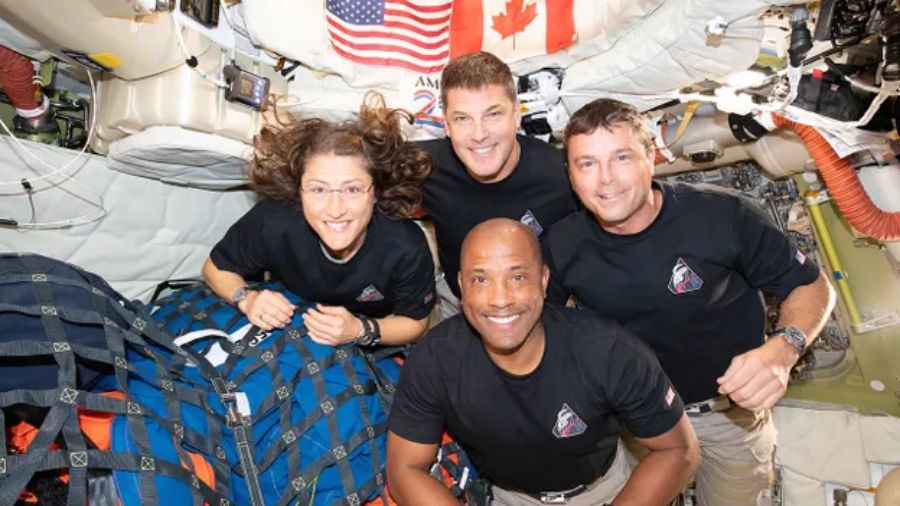
On April 10, at 5:07 p.m. Pacific time, four astronauts descended through Earth’s atmosphere at nearly 25,000 miles per hour and splashed into the Pacific Ocean roughly 60 miles off the coast of San Diego. The mission was over. The record books had already been rewritten.
Artemis II — NASA’s first crewed lunar mission since the Apollo era — carried its four-person crew farther from Earth than any human beings have traveled in 56 years, surpassing a distance record that had stood since 1970. It launched on April 1 from the Kennedy Space Center in Florida. Ten days later, it came home. The four astronauts aboard the Orion spacecraft were NASA’s Commander Reid Wiseman, Pilot Victor Glover, Mission Specialist Christina Koch, and Mission Specialist Jeremy Hansen of the Canadian Space Agency — the first Canadian to travel to lunar distance.
During their mission, the crew traveled 252,760 miles from Earth — eclipsing the 248,655-mile mark established by the Apollo 13 astronauts in 1970. That earlier record had been an unintended consequence of a near-disaster. This one was deliberate, planned, and executed with precision.
Each morning of the 10-day mission, the crew was awakened by music of their choosing — a tradition in human spaceflight stretching back more than 50 years. On their final morning in orbit, Mission Control played “Run to the Water” by Live.
Thirteen Minutes That Had to Go Right
The final phase of the mission required everything to work in sequence — and almost nothing could go wrong.
Artemis II lead flight director Jeff Radigan described the critical re-entry window at a Thursday press conference with characteristic directness.
“It’s 13 minutes of things that have to go right,” he said. “The forward bay cover has to come off, the drogues have to come out, the main chutes have to deploy, the reefing systems have to cut, and we have to get touchdown angle alignment correct.”
The sequence unfolded as follows: at approximately 7:33 p.m. ET, the service module separated from the crew module southeast of Hawaii. A final trajectory-adjustment burn at 7:37 p.m. fine-tuned the flight path. At 7:53 p.m., the capsule entered a six-minute communication blackout as plasma formed around the heat shield during peak heating — with temperatures reaching roughly 5,000°F and the crew experiencing up to 3.9 Gs of force.
Former astronaut Col. Jeff Williams described what that sequence feels like from inside.
“You’re weightless until you enter the upper parts of the atmosphere, and then you start feeling just a little bit of an acceleration,” he told Fox News. “If you weigh 200 pounds, you feel like 800 pounds.”
He called the parachute sequence “pretty violent” until the main chutes fully deploy — describing it as “the longest… minutes of your life.”
At 8:03 p.m. ET, drogue parachutes deployed. The three main parachutes opened at 8:04 p.m. Splashdown followed at 8:07 p.m. ET — exactly on schedule. NASA’s Mission Control described the return trajectory burn as “so perfect that we are dead on the centerline.”
The Heat Shield That Had to Hold
The re-entry demanded particular confidence in a component that had caused concern before.
During Artemis I — the unmanned lunar mission in 2022 — the Orion capsule’s heat shield sustained damage on return. Engineers determined that gases inside the shield’s Avcoat ablative material were unable to vent properly, leading to pressure buildup and charring that caused sections to break away in several locations.
For Artemis II, NASA redesigned the heat shield with a hexagonal configuration — subjecting it to extensive testing before clearing it for a crewed mission.
NASA press secretary Bethany Stevens confirmed that officials had full confidence in the updated design.
“It’s been through extensive testing here on Earth since Artemis I to make sure our crew is safe,” she said. “Safety is our utmost priority. And we are confident in our ability and Mission Control’s ability to make sure they splash down safely.”
NASA associate administrator Amit Kshatriya put it plainly at a Thursday press conference: there was “high confidence” in the heat shield — and “tomorrow the crew’s gonna put their lives behind that confidence.”
Recovery: From Ocean to Ship to Houston
Once the capsule hit the water, a carefully choreographed recovery operation began.
A four-person Navy dive medical team was the first to reach the capsule. Led by Lt. Cmdr. Jesse Wang — a board-certified emergency physician from Laguna Beach — the team included Senior Chief Hospital Corpsman Laddy Aldridge, who opened the capsule hatch; Chief Hospital Corpsman Vlad Link, with 18 years of dive medicine experience; and Hospital Corpsman 1st Class Steve Kapala, with eight years in dive medicine.
The team entered the capsule, conducted initial health evaluations, and assisted the astronauts into an inflatable raft. From there, they were airlifted by helicopter to the USS John P. Murtha — stationed approximately five miles from the splashdown point — where medical examinations continued.
The extraction order was deliberate: Mission Specialist Christina Koch first, lifted into helicopter one; Pilot Victor Glover into helicopter two; followed by Hansen joining Koch and Wiseman joining Glover for the transfer to the ship.
All four crew members were successfully recovered. They will subsequently fly to NASA’s Johnson Space Center in Houston to continue readapting to Earth’s gravity and reunite with their families.
The Orion capsule itself will be hauled aboard a Navy ship via winch and cradle, transported to U.S. Naval Base San Diego, and ultimately trucked to the Kennedy Space Center in Florida — aboard a platform NASA has nicknamed “the Armadillo” — for engineering inspection and data recovery.
“We Are Back in the Business of Sending Astronauts to the Moon”
Before the crew came aboard the USS John P. Murtha, NASA Administrator Jared Isaacman addressed the assembled service members with words that framed the mission’s significance beyond the immediate moment.
“For the first time, we’ve gone into the lunar environment in more than half a century,” Isaacman said. “We are back in the business of sending astronauts to the moon again.”
He pointed to a geopolitical dimension that gives the program urgency beyond scientific achievement.
“We have a geopolitical rival that’s challenging us right now,” he said. “Success and failure right now is going to be measured in months, not in years.”
Looking ahead to Artemis III — targeted for a 2028 moon landing near the lunar south pole — Isaacman was emphatic: “This time we’re going to stay, we’re going to build the moon base. We are never giving up.”
Dr. Lori Glaze, head of NASA’s Artemis program, offered her own window into why the south pole matters so much.
“The south pole is completely unexplored. No one has been there before,” she said. “We believe there is frozen water ice underneath the surface. We may be able to take advantage of that water ice and perhaps use it as a resource — we don’t have to actually bring water with us.”
Trump Celebrates — and Looks Ahead
President Donald Trump marked the crew’s safe return with a Truth Social post that evening, expressing pride and pointing toward the future.
“Congratulations to the Great and Very Talented Crew of Artemis II,” Trump wrote. “The entire trip was spectacular, the landing was perfect and, as President of the United States, I could not be more proud! I look forward to seeing you all at the White House soon.”
He closed with a hint at what he sees as the next frontier: “We’ll be doing it again and then, next step, Mars!”
Artemis II accomplished what it set out to do — and then some. A distance record broken. A crewed return to lunar space for the first time in more than half a century. A heat shield that held. A splashdown that landed exactly where and when it was supposed to. For the four astronauts who spent 10 days flying around the moon and returned home safely on April 10, the mission is over. For NASA, and for the United States’ ambitions in deep space, it is only the beginning.
