



It lasted long enough to trap a city bus, send bystanders scrambling from an oncoming car, and leave a public street covered in graffiti. When it was over, nobody had been arrested.
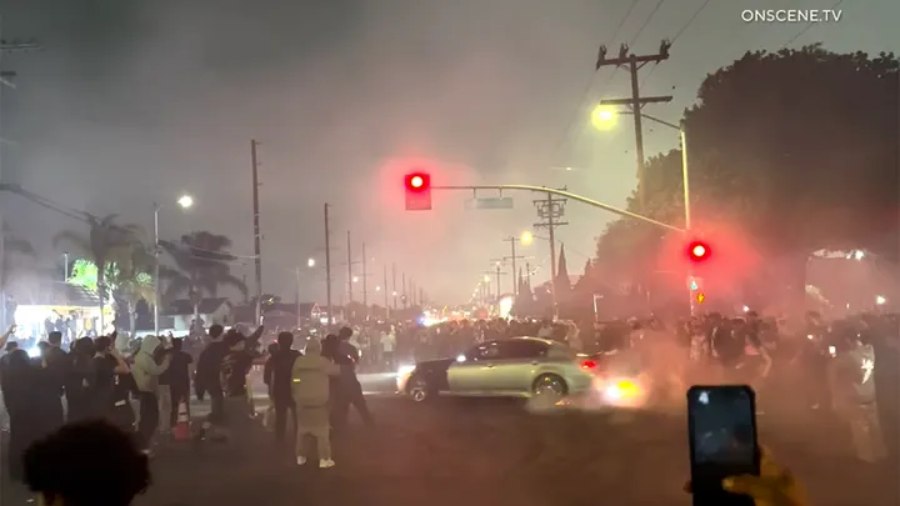
On the evening of March 22, a mob of more than 100 people descended on the corner of Alondra Boulevard and Figueroa Street in Los Angeles, seizing control of the intersection in what has become an increasingly familiar scene across the city. Video captured by OnScene.TV documented the chaos in full — and the footage is difficult to watch.
The takeover followed a pattern that residents and law enforcement have come to recognize all too well.
Drivers performed donuts at high speed while spectators pressed in dangerously close on all sides. At one point, a black sedan veered directly into the crowd. Onlookers scrambled in every direction to avoid being struck. One person was hit by the vehicle but was able to walk away from the scene without apparent serious injury.
Fireworks added another layer of danger to an already volatile situation. A blast erupting from the center of the intersection sent the surrounding crowd surging backward in alarm.
Throughout it all, a Los Angeles Metro Rapid bus — carrying both a driver and passengers — sat completely immobilized, surrounded by the mob and unable to move. Passengers inside could do little more than watch through the windows as approximately a dozen individuals climbed onto the roof of the bus while others below covered the vehicle in graffiti, coating even the windshield in spray paint.
A Thin Police Response
When law enforcement arrived, the response was limited.
The LAPD Street Racing Task Force — the unit specifically equipped to handle incidents of this nature — was not available to respond. In its place, two patrol cars were dispatched to a scene involving more than 100 people.
Sgt. Chris Carson of the LAPD Harbor Division spoke candidly to the Los Angeles Daily News about the challenges officers face in these situations.
“A lot of times, we get there and they’ve moved on,” Carson said. “The local residents don’t like it. We don’t like it. They take over a place and create a hazard. They block traffic. But we don’t have the people to go and grab everyone. They’ll run from us.”
The outcome reflected those constraints. When the crowd finally dispersed, no arrests had been made. Two vehicles were impounded. The LAPD did not respond to a request for comment submitted the following Monday.
The March 22 incident is not an isolated event — it is the latest chapter in an ongoing crisis that authorities have struggled to contain.
Last summer, a street takeover outside Crypto.com Arena — home to both the NBA’s Los Angeles Lakers and the NHL’s Los Angeles Kings — drew 50 vehicles whose drivers performed burnouts and donuts while spectators fired paintball guns at passing cars and set off fireworks, according to KTLA. Two individuals reportedly broke into a nearby storefront and looted merchandise during that event.
In a separate incident in Carson, California — part of Los Angeles County — authorities took a more aggressive enforcement posture, arresting 64 spectators, towing 25 vehicles, impounding two for 30 days, and issuing eight traffic citations, according to My News LA.
Calls for Tougher Consequences
With enforcement repeatedly falling short in the moment, attention has turned to whether stronger legal consequences might serve as a deterrent.
Los Angeles County District Attorney Nathan Hochman has publicly called for increased financial penalties targeting repeat participants in street takeovers — an acknowledgment that the current framework has not been sufficient to stem the problem.
Whether stiffer fines alone will prove effective against a phenomenon driven as much by social media visibility as by thrill-seeking remains an open question. What is not in question is that the incidents are continuing — and that the gap between the scale of the disruption and the scale of the law enforcement response remains wide.
The March 22 street takeover at Alondra Boulevard and Figueroa Street added another entry to a troubling and growing list of incidents that have made parts of Los Angeles feel increasingly ungovernable after dark. A trapped city bus, a car in the crowd, fireworks in the intersection, graffiti on a windshield — and zero arrests. Sgt. Carson’s words may be the most telling summary of where things stand: “We don’t have the people to go and grab everyone.” Until that changes — whether through increased resources, stronger deterrents, or both — there is little reason to expect the takeovers to stop.
