



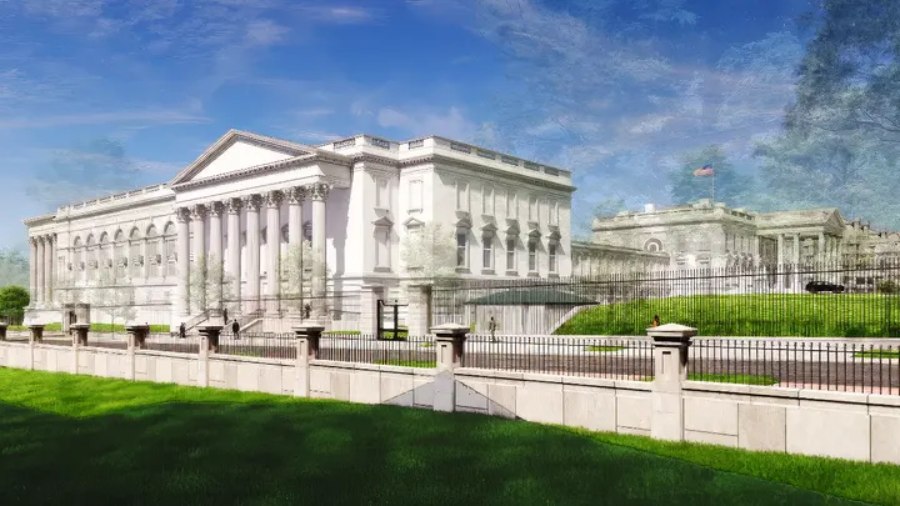
When President Donald Trump first unveiled plans for a new White House ballroom, the proposal was already generating controversy. Now, he has revealed that what is being constructed goes considerably deeper — both literally and strategically — than a venue for state dinners and dignitaries.
Speaking publicly on Sunday, Trump disclosed that the U.S. military is actively building a “massive complex” underneath the ballroom, tied directly to a broader set of security upgrades surrounding the site. The announcement adds a significant new dimension to a project that has already drawn fierce political debate.
Trump framed the ballroom and the underground complex as two components of a single, interconnected project — one designed not just for ceremony, but for security.
“The military is building a massive complex under the ballroom, and that’s under construction, and we’re doing very well,” Trump said.
The surface structure itself will incorporate an extensive array of modern protective features. Trump cited bulletproof glass throughout the building, along with drone-proof roofs and ceilings — a nod to the evolving nature of threats facing high-value government facilities.
“Everything is drone-proof and bulletproof, and unfortunately, we’re living in an age where that’s a good thing,” Trump said.
The underground construction, he confirmed, is already well underway.
Not a Dime of Taxpayer Money, Trump Says
One of the most politically charged aspects of the project has been the question of who is paying for it. Trump has been unambiguous on this point.
“All of the money paid is paid by myself and donors… it’s all donors,” he said. “There’s not one dime of government money going into the ballroom.”
The roughly $400 million project received formal approval in February from the U.S. Commission of Fine Arts, which fast-tracked the proposal following a unanimous 6-0 vote. The commission’s swift endorsement cleared the path for construction to begin on the site of the former East Wing — a structure that was demolished in October.
Trump added that progress has exceeded expectations on both timeline and cost.
“We’re ahead of schedule and under budget,” he said.
Beyond the security dimensions, the project addresses a practical limitation that has constrained White House operations for decades.
Previous administrations routinely relied on temporary structures to host large-scale events — a workaround driven by the old East Wing dining room’s maximum capacity of just 200 guests. For a building that serves as both the nation’s executive residence and its premier diplomatic venue, that ceiling has long been considered inadequate for major gatherings involving visiting heads of state and large delegations.
The new ballroom is designed to significantly expand that capacity, providing a permanent, purpose-built space for events at a scale the existing White House footprint could never accommodate.
Designed to Honor the Original
For all its modern security features and underground infrastructure, Trump was emphatic that the new structure would remain architecturally faithful to the building it adjoins.
“I think it’ll be the greatest ballroom anywhere in the world,” Trump said. “It pays total homage to the White House, which is, I think, very important.”
He described the design as carefully matched to the height, scale, and architectural style of the existing White House — an intentional choice to ensure the addition feels like an extension of the historic structure rather than an imposition on it.
The project has not been without its critics.
Democratic lawmakers have moved to place limits on the donor-funded construction, with some characterizing the arrangement as “bribery in plain sight” — a charge the administration disputes. A federal judge has also raised questions about the scope of presidential authority over the project, adding a legal dimension to the political controversy.
Former First Lady Michelle Obama publicly criticized the demolition of the East Wing, drawing further attention to the scale of the changes being made to one of the nation’s most symbolically significant buildings.
Whether the legal and political challenges gain traction remains to be seen. For now, construction continues — ahead of schedule, under budget, and deeper than most people initially realized.
The White House ballroom project has evolved from a headline-grabbing announcement into something considerably more complex — a multi-layered construction effort combining ceremonial ambition with serious security infrastructure. With a military-built underground complex, drone-proof and bulletproof protections, and a $400 million price tag covered entirely by private donors, the project is unlike anything previously undertaken at 1600 Pennsylvania Avenue. As construction accelerates, the debate over its funding, its legality, and its appropriateness shows no signs of slowing down.
