



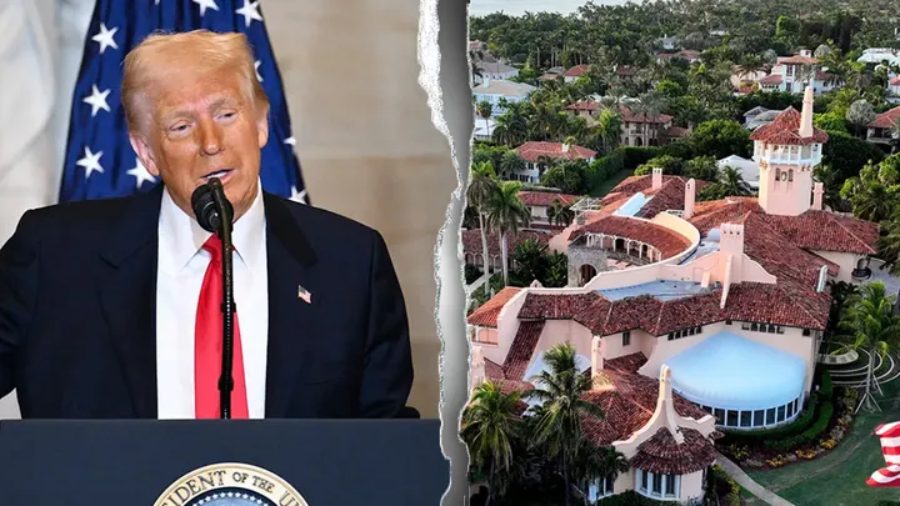
In the shadow of Mar-a-Lago, Democrats just delivered a message that will be difficult for Republicans to ignore.
On Tuesday, Democrat Emily Gregory defeated Republican Jon Maples in a special election for Florida’s House District 87 — a Palm Beach-anchored seat that sits squarely in President Donald Trump’s political and literal backyard. The Associated Press called the race for Gregory, making her the surprise winner of a contest that Maples had been widely favored to take.
The seat had been vacant since last August, when Republican state Rep. Mike Caruso resigned to become Palm Beach County clerk and comptroller. What was expected to be a routine Republican hold became, instead, the latest entry in a growing ledger of Democratic electoral upsets since Trump’s return to power.
This was not a race the president ignored.
Just one night before voters went to the polls, Trump posted a pointed endorsement of Maples on social media. “JON MAPLES HAS MY COMPLETE AND TOTAL ENDORSEMENT!” the president wrote, calling the contest “a very important Special Election” for Palm Beach County.
It did not carry the day.
Maples, 43, is a financial planner and former Lake Clarke Shores Council member who ran on a platform of cutting taxes and government spending, reducing regulations, promoting private sector job creation, and advancing school choice. He also had the backing of several prominent Florida Republicans beyond the president.
His opponent, Emily Gregory, 40, is an Army spouse who owns and operates a Jupiter-based fitness center focused on pregnant and postpartum women. Running for office for the first time, she centered her campaign on affordability, public education, property insurance costs, housing, and healthcare access — a message that clearly found purchase in a district assumed to be safely Republican.
Just How Red Was This District?
The scale of the upset becomes clearer when the electoral history of District 87 is examined.
Trump carried the district by roughly 10 percentage points in his 2024 re-election campaign. Before resigning, former Rep. Caruso won his last re-election there by 19 points. Maples entered the race with a fundraising advantage over Gregory and had the structural benefit of running in a district that has trended steadily rightward in recent cycles.
Palm Beach County, once reliably Democratic, has shifted toward Republicans over the past several election cycles — making Gregory’s victory all the more striking.
Tuesday’s result did not arrive in isolation.
Since Trump returned to the White House roughly 14 months ago, Democrats have compiled a string of wins and significant over-performances in special elections and off-year contests across the country. The Florida District 87 result adds to what Democrats describe as a sustained electoral trend — and one they believe previews what is possible in the November 2026 midterm elections, when control of the U.S. House and potentially the Senate will be at stake.
The Democratic National Committee wasted no time claiming the result as a defining moment.
“Donald Trump’s own neighbors just sent a crystal clear message: They are furious and ready for change,” said DNC Chair Ken Martin in a statement Tuesday night. “If Democrats can win in Trump’s own backyard, we can win anywhere. From now until November, Democrats are all gas and no brakes.”
Martin called Gregory’s win “an earthshattering victory for Florida Democrats and humiliating defeat for Donald Trump.”
Behind the electoral momentum, Democrats and analysts point to a consistent thematic through-line: cost of living.
With inflation continuing to weigh on American households, Democratic candidates across multiple states have made affordability the organizing principle of their campaigns. Gregory’s focus on property insurance, housing costs, and healthcare access reflected that same playbook — and in a high-cost county like Palm Beach, the message appeared to land.
The strategy is not unique to Florida. Democrats have used similar frames in special elections elsewhere, and the consistency of the over-performance suggests the approach is yielding results in a range of political environments.
Not everyone is ready to read sweeping national meaning into a single off-cycle state House race.
The Republican National Committee moved quickly to contextualize the result, arguing that special elections operate under dynamics that don’t reliably predict broader electoral trends.
“A low-turnout state House special election is a snapshot of local quirks, candidate dynamics, and turnout math — not some grand verdict,” said RNC Senior Adviser Danielle Alvarez in a statement.
The RNC’s point about turnout is not without merit — special elections routinely draw a fraction of general election participation, and the composition of who shows up can diverge sharply from a typical November electorate.
Still, for a party already navigating concerns about its midterm vulnerabilities, a loss in a district the president personally campaigned for — in a county that bears his name on its most famous address — is not easily dismissed.
The Other Florida Special Elections
District 87 was not the only contest on Tuesday’s docket in Florida.
In a separate state House special election, Republican Hilary Holley defeated Democrat Edwin Perez in the race to replace GOP state Rep. Josie Tomkow, in a district covering parts of Polk County in central Florida.
A third race — a state Senate special election between Josie Tomkow and Democrat Brian Nathan — remained too close to call at the time of publication. That contest is to fill the seat vacated by Republican Jay Collins, who resigned in August to become the state’s lieutenant governor. The district spans much of Democratic-leaning Tampa as well as the more Republican-leaning suburbs of northwest Hillsborough County.
None of Tuesday’s results will alter the partisan composition of Florida’s legislature, where Republicans have held majorities in both chambers for more than 25 consecutive years.
Florida’s legislative map won’t look any different after Tuesday. But the political conversation will.
A Democrat just won a race in the president’s own district — a race Trump endorsed, in a county his party has been gaining ground in for years, on terrain that should have been safely Republican. For a party working to translate special election momentum into a midterm wave, the District 87 result is precisely the kind of proof-of-concept that energizes donors, recruits candidates, and sharpens a message.
Whether the pattern holds when tens of millions of voters — not just a low-turnout special election pool — show up in November remains the defining question. Republicans will argue the gap between a special and a general is vast. Democrats will argue the trend is real.
Tuesday’s result in Palm Beach ensures that argument will grow louder between now and November.
