



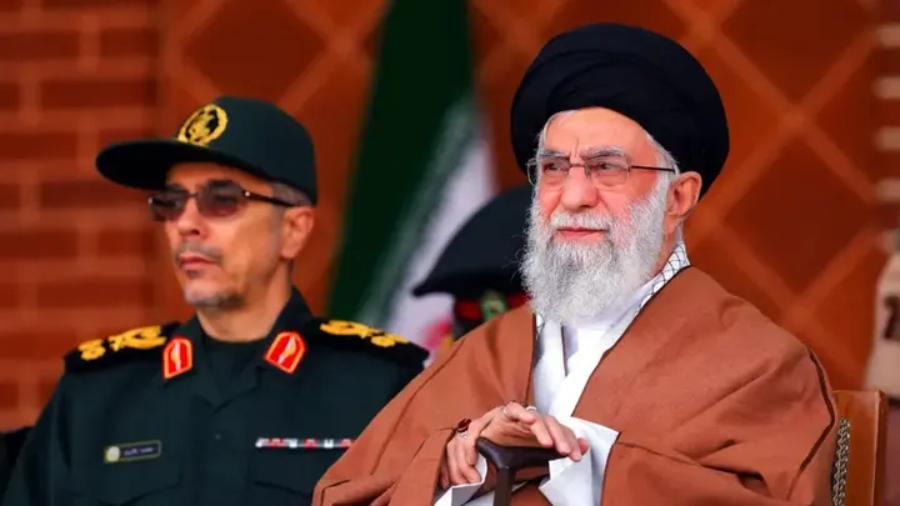
A second Israeli airstrike targeting a gathering point for Iran’s senior clerical establishment in the holy city of Qom has dramatically deepened the regime’s crisis, leaving what remains of its leadership fractured, fearful, and racing against time to preserve any semblance of institutional continuity — even as those institutions themselves become military targets.
The strike hit a building where members of Iran’s Assembly of Experts had reportedly convened — or were scheduled to convene — to begin deliberating one of the most consequential decisions in the Islamic Republic’s 45-year history: who should succeed Supreme Leader Ayatollah Ali Khamenei, killed days earlier when an Israeli airstrike leveled his compound in Tehran. Israeli Defense Forces spokesman Brigadier General Effie Defrin confirmed the strike on the Qom location, though the exact number of the Assembly’s 88 members present at the time remains uncertain, according to Israeli defense sources.
The timing and precision of the strike carry a message that goes far beyond military damage. By hitting the very site where Iran’s clerics were attempting to manage an orderly succession, Israel signaled that it possesses both the intelligence and the willingness to disrupt Iran’s internal governance mechanisms at their most vulnerable moment.
“Insecure and Hunted”
Kobi Michael, a senior researcher at the Institute for National Security Studies and the Misgav Institute, described the psychological and institutional toll in stark terms. “This second strike would be another embarrassment to what has been left of the regime,” he told Fox News Digital. “As of now, the leadership would feel insecure and hunted, with all of their plans collapsing one after another.”
The phrase “collapsing one after another” captures something critical: it is not merely the physical destruction that threatens the regime, but the collapse of its decision-making processes. The Assembly of Experts is constitutionally the only body empowered to select, supervise, and if necessary dismiss the Supreme Leader. With its members unable to safely assemble, Iran’s constitutional machinery for transitioning power is effectively paralyzed — creating a dangerous vacuum at the very apex of a theocratic state already under unprecedented military pressure.
Michael warned that the internal threat may prove as destabilizing as the external one. “They would feel totally isolated and understand that the biggest risk might come from home — from a potential uprising next,” he said. Decades of political repression, economic mismanagement, and the violent crushing of protest movements — most recently in 2019 and 2022 — have stored enormous reserves of public grievance. A leadership visibly unable to protect itself, let alone govern, could become the catalyst that transforms latent discontent into open revolt.
The Broader Campaign: Operation Epic Fury
The Qom strike is the latest development in a sweeping, coordinated military campaign. According to a U.S. Central Command fact sheet cited by Fox News Digital, American forces alone have struck more than 1,700 targets across Iran in the first 72 hours of what has been designated Operation Epic Fury — an operational tempo that reflects months, if not years, of intelligence preparation.
The targets read like a systematic dismantling of the architecture of Iranian state power: command-and-control centers, the Islamic Revolutionary Guard Corps Joint Headquarters, the IRGC Aerospace Forces headquarters, integrated air defense networks, and ballistic missile storage and launch sites. The stated objective is to neutralize what U.S. officials describe as imminent and existential threats — but the scale of the campaign suggests an ambition that extends beyond neutralization toward fundamental transformation of Iran’s military and political capacity.
The IRGC, which functions simultaneously as a military force, an intelligence apparatus, an economic empire, and the ideological enforcer of the clerical state, is clearly a primary target. Decapitating its command structure does not merely degrade Iran’s ability to project force regionally — through proxies in Lebanon, Yemen, Iraq, and Gaza — it strikes at the organizational backbone that has kept the Supreme Leader’s authority operational and enforceable.
A Succession Crisis Without Precedent
Iran has faced a leadership transition once before, in 1989, when Ayatollah Khomeini died and Ali Khamenei — then a relatively junior cleric — was elevated to the position by a process that involved significant behind-the-scenes political maneuvering. That transition occurred in peacetime, with institutions intact and the IRGC fully functional as a guarantor of stability.
The current moment could not be more different. Khamenei’s death has come under conditions of active warfare, with the regime’s security apparatus under sustained attack, its members unable to gather safely, and its international isolation more complete than at any prior point. The Assembly of Experts must now attempt to navigate one of the most consequential decisions in modern Middle Eastern history while its members are potential targets and its meeting places are known to enemy intelligence.
The candidates most frequently discussed in Iranian political circles — including judiciary chief Ebrahim Raisi’s allies and figures associated with Khamenei’s own son, Mojtaba — each carry their own factional liabilities and legitimacy deficits. A successor chosen under these conditions, lacking the religious credentials of Khomeini or the long political cultivation of Khamenei himself, may struggle to command the deference of either the clerical establishment or the IRGC, whose interests do not always align.
“Iran Will Not Be Like We Used to Know”
Kobi Michael’s closing assessment carries the weight of an epitaph for an era: “We need strategic patience and determination, and in several weeks most of the job will be accomplished. Even if the regime does not collapse, Iran will not be like we used to know.”
That formulation — even if the regime does not collapse — is telling. It acknowledges the genuine uncertainty about whether coordinated military pressure can bring down a deeply entrenched theocratic state with 85 million people and half a century of institutional roots. History is littered with regimes that absorbed extraordinary punishment and survived. But it also acknowledges something equally significant: that survival and restoration are not the same thing. A post-campaign Iran, stripped of its missile arsenals, its IRGC command structures, and its Supreme Leader, would be a fundamentally diminished power — unable to project regional influence, stripped of its nuclear ambitions, and forced into a period of internal reconstruction whose political outcome remains genuinely unknown.
Whether that outcome is a more moderate Iran, a more chaotic one, or something else entirely may depend less on what happens in the coming weeks of military operations than on what fills the vacuum after they conclude.
