



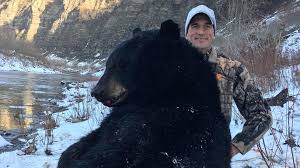
Just before melting snow marked the end of muzzleloader season, a longtime Letchworth State Park hunter experienced an unexpected and rare moment deep in the park’s rugged backcountry.
On the second-to-last day of the season, Matt Sphar was positioned along a steep, hemlock-lined ridge overlooking the Genesee River. Having already harvested a buck during the regular gun season and another during archery season, Sphar and fellow hunters were focusing their efforts on does in a remote section of the park. As he prepared to move through the woods to push deer toward a nearby field, he encountered something entirely unforeseen.
“It was pretty wild. I didn’t expect to see a big black bear about 40 yards away,” Sphar said. “At first, I was conflicted. I don’t want to kill a bear, but I had a tag, and this was a once-in-a-lifetime opportunity.”
Sphar said the bear appeared unaware of his presence, pawing at the forest floor and feeding on acorns. He knew from conversations with park police that bear hunting was permitted in the park this year, but he also understood the ethical responsibility to avoid harvesting a sow with cubs.
“I watched it for a while,” he said. “I didn’t see any cubs, and I had a clear view of the surrounding area. Cubs usually stay close to their mother, especially when bears are active. After observing for some time, I was confident it wasn’t a female with young.”
With a clear and ethical shot, Sphar fired his muzzleloader. The bear was hit hard and slid down the steep ridge out of sight. As daylight faded, Sphar and his companions agreed to wait until morning to track the animal.
The next day, with snow largely gone and the terrain slick and muddy, Sphar returned with six others to help recover the bear. They found it far below, near the river, having slid down shale and steep slopes.
“We all knew getting down there would be tough, and getting him back up would be even tougher,” Sphar said. “We followed well-worn deer trails to reach him.”
The group confirmed the bear was a mature male, estimated to weigh between 300 and 400 pounds. Measuring roughly 80 inches from nose to hind foot, the animal stretched just over six feet in length.
Once recovered, the demanding work of packing the bear out began. Sphar, who describes himself as a meat hunter, was committed to utilizing the entire animal.
“We de-boned everything because there’s no way you can carry an animal like that whole in terrain like this,” he said. “Even then, each person could only carry so much. I carried the intact hide, head, and paws, which weighed about 60 pounds.”
The meat will be shared among those who helped with the recovery, and the hide will eventually be made into a rug.
Handling the bear up close left a lasting impression on Sphar.
“I have a huge amount of respect for these animals,” he said. “Seeing the size and power of a bear up close, especially the forearms, is incredible. They’re amazingly strong.”
This is the first year the state has allowed bear hunting on park land, and Sphar believes only a few bears have been taken from Letchworth this season. A lifelong hunter, trapper, and angler, Sphar works as an arborist and spends much of his time in the woods. He lives in North Java with his wife, Becky, and their two young children.
For Sphar, the experience was both humbling and unforgettable, a rare moment in a lifetime spent deep in the forests of the Genesee Valley.
