



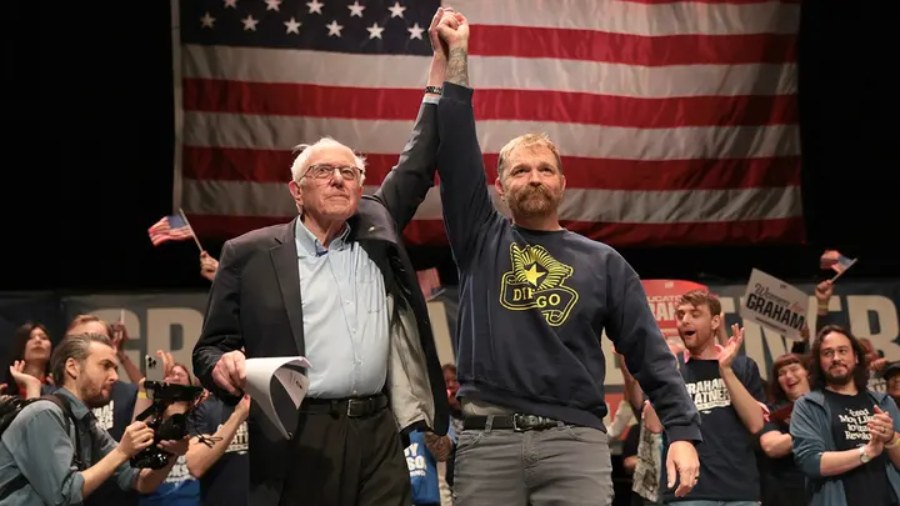
A closed-door meeting in Washington became the latest pressure point for Graham Platner, the Maine Democratic Senate candidate whose campaign is now fighting political turbulence just days before voters head to the primary polls.
Platner traveled to Washington, D.C., on Tuesday to meet with Democratic senators as his campaign faced growing questions over alleged explicit text exchanges, resurfaced online posts, a deleted Kik account and a tattoo linked to Nazi imagery. The meeting came one week before Maine’s June 9 Democratic Senate primary, where Platner is set to face David Costello for the nomination.
The winner of that primary will move on to challenge five-term Republican Sen. Susan Collins in the general election, making the race one of the closely watched Senate contests of the cycle. Reuters reported that Senate control is central to the stakes of the Maine race, with Republicans holding a 53-47 majority.
The Washington Meeting
Platner’s visit to the Democratic Senatorial Campaign Committee building came at a sensitive moment for his campaign.
Democratic senators entering or leaving the meeting were pressed by reporters about whether they still supported him despite the controversies. Some gave brief answers. Others avoided the questions entirely.
Sen. Kirsten Gillibrand, D-N.Y., expressed confidence in the party’s chances in Maine when asked whether she still supported Platner.
“I’m very confident we are going to win Maine,” Gillibrand told reporters.
When pressed directly on whether she had confidence in Platner, she repeated that Democrats would win the state.
“I do. I have confidence that we are going to win Maine and I have no doubt,” she said.
Her response did not address the specific allegations surrounding Platner, but it signaled that at least some Democrats were not publicly backing away from him.
Sen. Bernie Sanders, I-Vt., offered a more direct defense.
Rather than focus on the scandals, Sanders pointed to the amount of money being spent on advertising in Maine against Platner. He said wealthy interests had reserved nearly $100 million in television ads in the small state.
“All I can tell you is that the wealthiest people in this country have now reserved close to $100 million in TV ads in a small state like Maine,” Sanders said.
He then framed that spending as evidence that powerful interests viewed Platner as a threat.
“So what are the billionaires worried about? Why are they spending so much money trying to defeat this guy?” Sanders asked.
“The answer is that he’s going to stand up to the oligarchies,” he said before the meeting.
Sanders’ comments placed Platner’s troubles inside a broader populist argument: that the attacks against him are tied to money, power and political fear rather than only personal conduct.
Other Democrats Keep Their Distance
Not every Democrat offered a full-throated defense.
Sen. Elizabeth Warren, D-Mass., declined to answer reporters’ questions about the controversies surrounding Platner as she entered the DSCC headquarters.
Sen. Peter Welch, D-Vt., took a more cautious position. He said the outcome would be decided by Maine voters.
Asked whether a more moderate electorate would support Platner, Welch replied, “We’ll see.”
Those answers reflected the difficult position facing Democrats: Platner remains a major figure in the primary, but the controversies around him have created political risk at a critical stage of the race.
Platner’s campaign has faced several waves of scrutiny.
One controversy centers on a Wall Street Journal report that his wife discovered sexually explicit text exchanges with multiple women just months after the couple married in 2024. The Associated Press also reported that Platner faced renewed scrutiny over sexually explicit messages with multiple women while married, and that his wife, Amy Gertner, criticized the coverage as “shameful.”
In a statement sent to Fox News Digital, Platner said, “Amy and I went through something hard — because of me.”
He added that they “did the work” and said he was grateful for her. Platner also argued that voters were more focused on issues such as hospitals, paychecks and children than on “gossip or headlines.”
The campaign also addressed a Kik account that appeared to belong to Platner and featured a sexually suggestive shirtless photo of him wearing only a towel. His campaign told Fox News Digital that the account was created while he was single and had long been deleted from his phone.
Beyond the text allegations, Platner has also been criticized over a Nazi-linked tattoo and resurfaced online posts. One post from 2019 reportedly said Purple Heart veteran Teddy Daniels “didn’t deserve to live.”
Why the Maine Race Matters
The controversy around Platner is not unfolding in an ordinary race.
Maine’s Senate contest is politically significant because the Democratic nominee will face Susan Collins, a long-serving Republican incumbent who has won statewide races for decades. Reuters reported that Platner is expected to challenge Collins if he secures the Democratic nomination.
That makes the timing of the Washington meeting especially important.
Platner’s trip came just days before the primary, while Democrats were being asked whether the controversies had changed their view of him. For his supporters, the attacks may be viewed as an attempt to weaken a candidate they believe can challenge entrenched power. For critics, the accumulation of allegations raises questions about judgment, electability and what else could surface in a general election campaign.
The result is a political test for both Platner and the Democratic senators now being asked to defend, distance themselves from or carefully avoid commenting on his candidacy.
Graham Platner’s Washington meeting was meant to bring him face-to-face with Democratic senators before Maine’s June 9 primary. Instead, it underscored the central problem now surrounding his campaign: the race is no longer only about defeating Susan Collins.
It is also about whether Democratic leaders believe Platner can survive the growing scrutiny around his conduct, past posts and personal controversies.
For now, some Democrats are brushing off the questions, others are refusing to engage, and Sanders is framing the fight as a battle against wealthy interests. But Maine voters will decide first — and their verdict will determine whether Platner’s scandals become a primary-season crisis or a general-election burden.
