



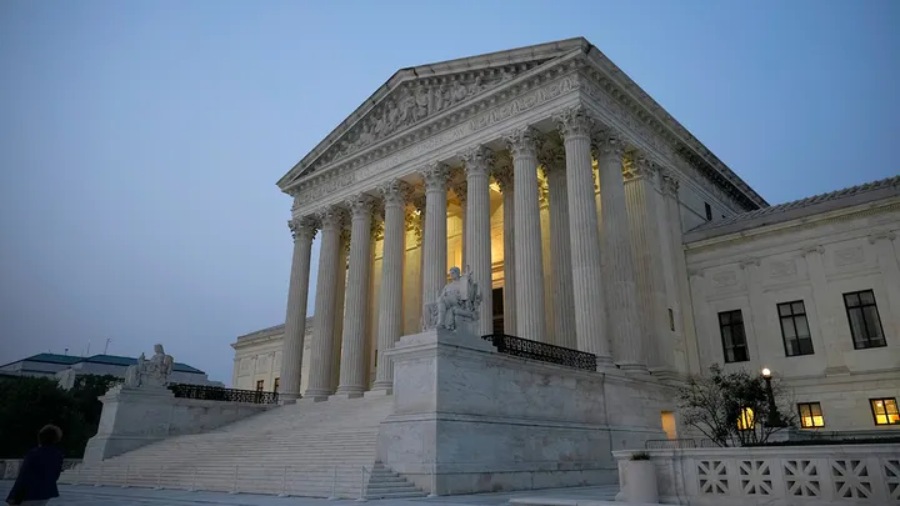
Virginia Democrats mounted a months-long, $70 million campaign to redraw the state’s congressional maps ahead of the 2026 midterms. They got voters to approve the revised districts by a narrow margin at a special April election. And on Friday, the United States Supreme Court declined to save them.
In a brief unsigned order — with no justice publicly dissenting — the nation’s highest court rejected Virginia Democrats’ emergency request to block a Virginia Supreme Court ruling that had already invalidated the voter-approved redistricting overhaul. The decision leaves the current congressional maps intact as the 2026 election cycle accelerates.
The core legal problem identified by the Virginia Supreme Court in its May 8 ruling was procedural — and the justices found it insurmountable.
In a 4-3 decision, the state’s high court concluded that Virginia’s constitutional amendment process requires the General Assembly to pass a proposed amendment, allow an intervening election to occur, and then pass it again. The flaw: lawmakers advanced the redistricting proposal after early voting had already begun in the election that was supposed to serve as the required intervening cycle.
Under that timeline, voters were already casting ballots before the General Assembly had completed the first passage of the amendment. The Virginia Supreme Court ruled that this procedural sequence “incurably taints the resulting referendum vote” — effectively erasing the April special election result regardless of how voters cast their ballots.
Virginia Democrats had pushed back hard against that reasoning, arguing in their emergency appeal to the U.S. Supreme Court that the Virginia ruling had “deprived voters, candidates and the Commonwealth of their right to the lawfully enacted congressional districts.”
The Supreme Court’s one-line refusal to intervene ended that argument.
What the Map Was Designed to Do
The redistricting overhaul that has now been invalidated was not a neutral exercise in good-government cartography. It was a deliberate political effort to shift the competitive landscape of Virginia’s congressional delegation ahead of an election that could determine which party controls the U.S. House of Representatives.
Democrats designed the proposed maps to make multiple Republican-held Virginia congressional seats significantly more competitive — a move that, if it had survived legal challenge, could have yielded anywhere from two to four additional Democratic House seats in a chamber where Republicans currently hold a slim majority.
The stakes made the legal fight national in scope and financial ambition. Democrats reportedly invested approximately $70 million in the effort to pass the referendum and defend it through the courts.
All of that investment has now produced no maps and no seats — only a legal precedent about the procedural requirements for amending Virginia’s constitution.
Gov. Spanberger Responds
Virginia Gov. Abigail Spanberger — who had championed the redistricting effort and framed it as a democratic check on presidential overreach — did not accept the courts’ conclusions quietly.
In a post on X following the Supreme Court’s denial of the emergency request, Spanberger cast both rulings as an affront to democratic participation.
“The Supreme Court of the United States has now joined the Supreme Court of Virginia in choosing to nullify an election and the votes of more than three million Virginians,” she wrote.
“These Virginians made their voices heard — casting their ballots in good faith to push back against a President who said he’s ‘entitled’ to more seats in Congress before voters go to the polls.”
She closed with a forward-looking message about voter mobilization, pledging to ensure Virginians know “when and how to cast their votes this year.”
Her framing — positioning the courts as having overridden democratic will — is likely to become a central element of Democrats’ messaging heading into the November elections, even as the legal avenue for map changes has now been closed.
The Bigger Picture
The Virginia redistricting battle does not exist in isolation. It is one theater in a nationwide war over congressional maps being waged simultaneously in multiple states as both parties attempt to engineer electoral advantages ahead of 2026 without waiting for the next census-triggered redistricting cycle.
Republicans have responded to Democratic mid-decade redistricting efforts with their own, including a Florida map that GOP legislators advanced to offset Democratic gains elsewhere. Both sides have framed their efforts as defensive responses to the other’s aggression.
With the Virginia maps now preserved and the legal window for changing them essentially closed ahead of November, the redistricting battlefield shifts to other states — and to the electoral arithmetic that will determine which party emerges from the midterms in control of the House.
Virginia Democrats spent $70 million, ran a special election, won it — and still lost. The Virginia Supreme Court found a procedural defect that the vote could not cure. The U.S. Supreme Court declined to say otherwise. The maps stay as they are. And Gov. Spanberger is left to argue that more than three million voters were ultimately disenfranchised by a constitutional technicality about when early voting begins relative to a legislative vote.
Whether that argument resonates with Virginia voters in November — or whether the legal defeat becomes a mobilizing narrative for Democratic turnout — may matter more than the maps themselves. Control of the House is likely to come down to a handful of competitive seats. Virginia’s may now be decided by lines that the courts, not Democrats, get to keep.
