



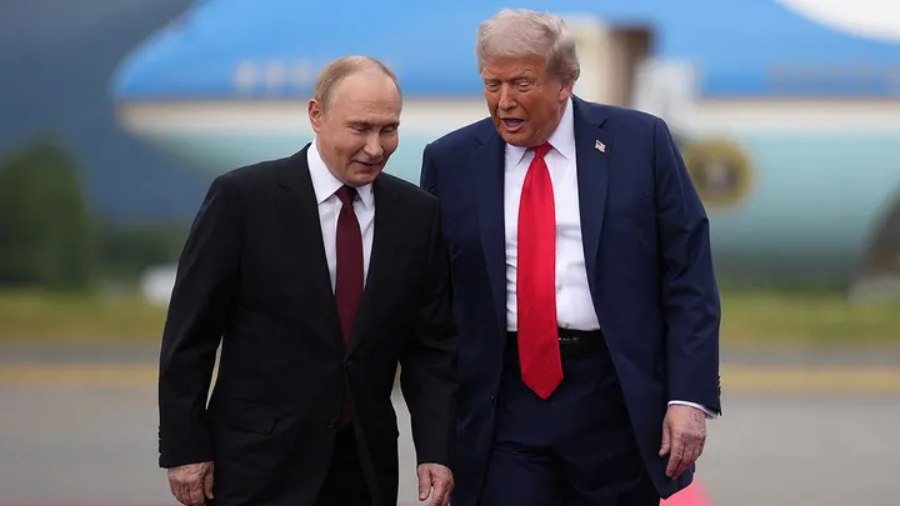
For more than four years, the war in Ukraine has defied every prediction of its end. On Saturday, the man who started it said he believes that end may finally be approaching.
“I think that the matter is coming to an end,” Russian President Vladimir Putin told reporters, according to Reuters — a statement that, coming from the Kremlin, carries weight precisely because of how rarely anything resembling optimism about peace has emerged from that direction.
The comment arrived on the same day a Trump-brokered three-day ceasefire took effect, suspending all military activity along the front lines as both nations observe a period of commemoration and, for the first time in years, a structured pause in the fighting.
What Trump Announced
President Donald Trump announced the ceasefire on Friday via Truth Social, framing it around the historical occasion that prompted it.
“The celebration in Russia is for Victory Day but, likewise, in Ukraine, because they were also a big part and factor of World War II,” Trump wrote, tying the pause in hostilities to May 9 — the date Russia marks the Soviet Union’s World War II victory — and extending it through Monday, May 11.
The agreement goes beyond a simple halt in fighting. Trump confirmed it includes a 1,000-for-1,000 prisoner exchange between the two nations — a massive swap involving captured soldiers from both sides.
“This ceasefire will include a suspension of all kinetic activity, and also a prisoner swap of 1,000 prisoners from each country,” Trump wrote. “This request was made directly by me, and I very much appreciate its agreement by President Vladimir Putin and President Volodymyr Zelenskyy.”
Russia simultaneously scaled back its Victory Day parade to its most modest iteration in years — a visual signal, intentional or otherwise, of a conflict whose psychological weight has shifted from triumphalist celebration to something considerably more complicated.
Zelenskyy Confirms — and Calls on the U.S. to Enforce
Ukrainian President Volodymyr Zelenskyy confirmed the terms of the agreement in a post on X, providing his own accounting of how the exchange was structured and what he expects to follow.
“Within the framework of the negotiating process mediated by the American side, we received Russia’s agreement to conduct a prisoner exchange in the format of 1,000 for 1,000,” Zelenskyy wrote. “A ceasefire regime must also be established on May 9, 10, and 11. Ukraine is consistently working to bring its people home from Russian captivity. I have instructed our team to promptly prepare everything necessary for the exchange.”
Zelenskyy acknowledged Trump’s diplomatic involvement with explicit gratitude — and made clear where he believes responsibility for enforcement now lies.
He said he hopes the United States will ensure Moscow abides by the agreement — a pointed reminder that Ukraine has learned, through four years of broken assurances, not to take Russian compliance as a given.
The U.S. Special Envoy Steve Witkoff separately confirmed that U.S., Ukrainian, and Russian delegations had formally agreed to the prisoner swap terms.
Putin’s Conditions for Direct Talks
While Putin’s statement about the war “coming to an end” was notable, his other comments at the same session were a reminder of how much distance remains between the two sides on the path to a permanent resolution.
Asked about direct engagement with European leaders, Putin said he would prefer to communicate through former German Chancellor Gerhard Schroeder — a longtime personal contact — rather than through current European government heads.
More significantly, Putin stated that he would only consider holding direct talks with Zelenskyy after a lasting peace deal had already been agreed upon — effectively conditioning any personal diplomatic engagement on an outcome that has not yet been achieved.
The position reinforces a pattern that has defined Russia’s approach to diplomacy throughout the conflict: engaging with the process on terms that minimize Kyiv’s standing as an equal party to any negotiation.
A War That Has Defied All Timelines
The Russia-Ukraine war entered its fifth year having confounded nearly every projection made about it. Russia launched its full-scale invasion in February 2022 with what senior officials believed would be a swift and decisive campaign. More than four years later, the Kremlin has still not captured the entire Donbass region — the stated core objective of the war’s later phase — and has absorbed staggering human and material losses in the attempt.
Ukraine, for its part, has survived far longer than early assessments suggested it could — sustained by Western military and financial support, and by a resistance that has repeatedly proven more durable than its opponents anticipated.
Into that stalemate, Trump’s three-day ceasefire arrives as something genuinely new: a structured, internationally acknowledged pause, with prisoner exchanges, brokered by a U.S. president who has made ending the conflict a stated diplomatic priority.
Whether it represents the beginning of a path toward peace — or another temporary pause in a conflict that has defied every attempt to end it — is the question that the next 72 hours will begin, but almost certainly not finish, answering.
Vladimir Putin saying the war “is coming to an end” is not a peace agreement. A three-day ceasefire is not a permanent settlement. And a 1,000-prisoner exchange, however significant for the families involved, is not a resolution to a conflict that has reshaped European security, consumed hundreds of thousands of lives, and tested the limits of Western resolve for more than four years. What Saturday represents is a moment — a pause, a gesture, and perhaps the earliest stages of something larger. Trump is calling it a step toward peace. Putin is saying the end may be near. Zelenskyy is watching to see if Russia actually holds the line it agreed to. The next three days will tell part of the story. The rest will take considerably longer.
