



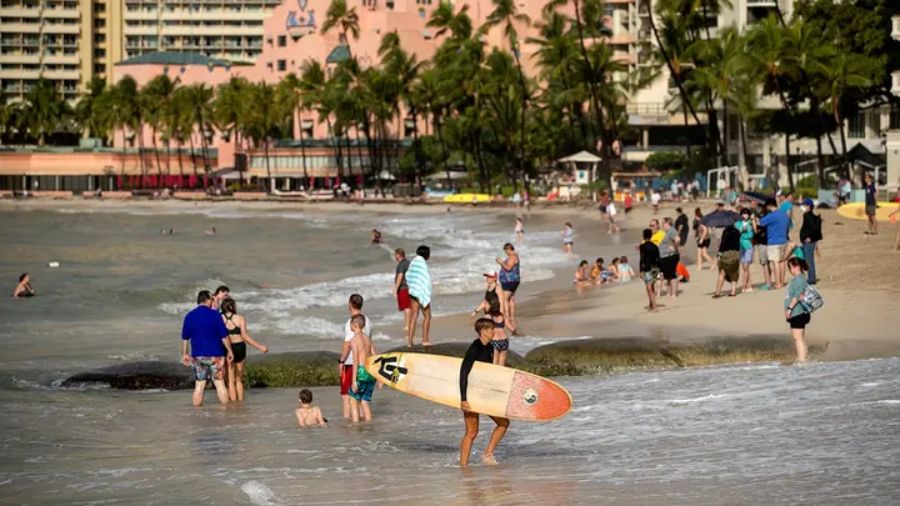
For thousands of visitors arriving in Hawaii during one of the year’s busiest travel periods, the picture-perfect beach vacation they planned looks considerably different right now.
Hawaii health officials have issued brown water advisories covering beaches across multiple islands in the wake of a powerful Kona Low storm that pushed through the state earlier last week. The warning is straightforward, and the Hawaii Department of Health Clean Water Branch has condensed it into six words:
“If the water is brown, turn around.”
The timing could hardly be worse for the spring travel season. The Kona Low system that triggered the current advisories was not an isolated event — it was the third such storm to hit Hawaii within a single month, according to Fox Weather.
That accumulation matters. It means the ground across multiple islands was already heavily saturated before the latest storm arrived — limiting the land’s ability to absorb additional rainfall and accelerating the flow of runoff directly into coastal waters.
Officials noted the advisories are also layered on top of lingering contamination effects from an unusually wet March, meaning some beaches were already under elevated scrutiny before the latest round of storms arrived.
What’s in the Water — and Why It’s Dangerous
The advisories are not precautionary in the abstract. They reflect specific, measurable contamination risks that storm runoff introduces to ocean waters — and the list of what that runoff can carry is sobering.
Heavy rainfall washing across developed and agricultural land picks up sewage overflow, pesticides, and animal waste as it moves toward the coast. When that material reaches the ocean, it raises the concentration of bacteria including E. coli and salmonella to levels that pose genuine health risks for swimmers and surfers.
Storm runoff also deposits debris in coastal waters, creating additional hazards for anyone in the ocean. Officials flagged one more concern that may surprise some visitors: murky water conditions can attract marine life, including sharks — drawn closer to shore by reduced visibility and the presence of organic material carried in by runoff.
Which Areas Are Affected
The scope of the current advisories is extensive.
Kaua’i is under an island-wide warning — meaning no coastal waters on the island are currently considered safe for swimming. On O’ahu, Maui, and the Big Island, multiple specific areas are also under active advisories, according to the Hawaii Department of Health.
Advisories are not lifted uniformly — they are evaluated and removed on a beach-by-beach basis as water quality testing shows improvement. Officials advise travelers to monitor local updates in real time rather than assuming a previous advisory has been resolved.
Even in cases where an advisory has technically been lifted, health officials recommend staying out of the water if it still appears brown or murky — a visible sign that runoff contamination may still be present regardless of the official status.
How Long Should Visitors Wait?
The standard recommendation from officials is to avoid ocean entry for a minimum of 48 to 72 hours after rainfall stops. However, they were explicit that this timeline may need to be extended under current conditions.
With continued unsettled weather in the forecast and heavily saturated ground across the islands unable to absorb additional water quickly, runoff is likely to continue affecting coastal areas even as individual storm systems move through. The practical implication for visitors is that conditions may remain unsafe for longer than the standard window suggests.
Officials are encouraging travelers to treat the 48-to-72-hour guideline as a floor rather than a fixed endpoint — and to check local water quality updates before entering the water regardless of when the last rainfall occurred.
Storms That Left More Than Wet Beaches
The Kona Low systems have caused damage that extends well beyond beach closures.
The back-to-back storms triggered evacuations across parts of O’ahu, with residents forced from their homes as floodwaters rose in residential areas. Cleanup efforts remain ongoing across affected communities, with volunteers working to clear debris and damaged household items in neighborhoods including Waialua.
Fox News correspondent Christina Coleman reported there were no confirmed deaths or missing persons tied to the flooding — a measure of relief amid otherwise significant disruption.
Travelers React
Among those most immediately affected are spring break visitors who arrived in Hawaii expecting beach access as the centerpiece of their trips. Frustration has surfaced on social media, where some travelers turned to local residents and online communities for guidance on current conditions.
“We are staying in Kīhei, a little bummed,” one visitor wrote on Reddit. “I hope the storm passes quickly.”
Others asked directly whether it was safe to enter the water despite the advisories. The response from local residents was consistent: don’t.
“Many residents strongly advised against it, warning the risks can be serious even if conditions appear calm,” Fox News reported — a reminder that brown water hazards do not always present visually once contamination has mixed with cleaner water at the shoreline.
Hawaii’s beaches are among the most visited in the world — and right now, health officials are asking visitors and residents alike to stay out of them. The brown water advisories covering Kaua’i, O’ahu, Maui, and the Big Island reflect a genuine public health concern backed by the specific contaminants that storm runoff introduces into coastal waters. With the third Kona Low storm in a month having pushed through the islands, and saturated ground conditions slowing recovery, the timeline for safe swimming remains uncertain. The message from the Hawaii Department of Health is clear: when in doubt, stay out.
