



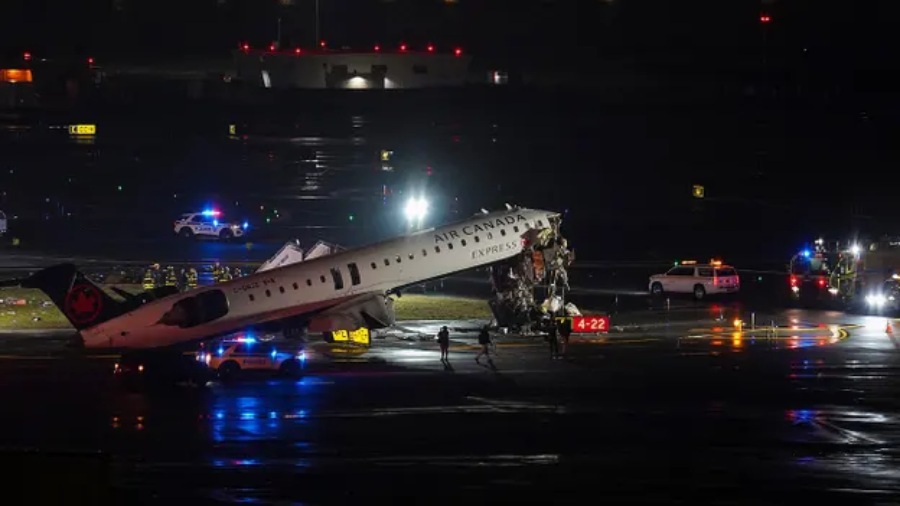
Just before midnight on a Sunday, a routine arrival from Montreal turned catastrophic at one of the busiest airports in the United States.
An Air Canada Express CRJ-900 regional jet, operated by Jazz Aviation, was on final approach to Runway 4 at New York’s LaGuardia Airport around 11:45 p.m. when it struck a Port Authority Aircraft Rescue and Firefighting vehicle head-on. The impact ripped the nose completely off the plane, killing both the captain and the first officer instantly.
It was one of the deadliest runway collisions in recent American aviation history.
Federal officials have begun piecing together how a fire truck and a passenger jet ended up on the same strip of pavement at the same time.
FAA Administrator Bryan Bedford confirmed the emergency vehicle had not been dispatched randomly — it was responding to a separate rejected takeoff by a United Airlines aircraft that occurred shortly before the Air Canada flight touched down. That vehicle, in the wrong place at the wrong moment, became the point of collision.
Air traffic control audio captured in the final seconds before impact tells a chilling story. A controller can be heard granting the truck clearance to cross, then immediately recognizing the error.
“Stop, Truck 1. Stop,” the transmission records. “Stop, stop, stop, stop.” The frantic commands came too late.
Video from the scene shows the jet striking the fire truck directly head-on, with the aircraft’s nose absorbing the full force of the collision.
Both pilots aboard the Jazz Aviation flight were killed on impact. Their identities have not yet been publicly released.
Of the 72 passengers and 4 crew members aboard, more than 39 people were hospitalized, including two Port Authority firefighters who sustained broken bones but were expected to survive. At least 32 individuals have since been discharged, though officials confirmed that some sustained “serious injuries.”
One story emerging from the wreckage has stunned investigators and the public alike.
A flight attendant — identified by her daughter as Solange Tremblay — was ejected from the aircraft upon impact, still buckled into her jump seat, and was found approximately 100 meters from the plane. She was rushed into surgery for multiple fractures and breaks to her right leg.
Her daughter, Sarah Lépine, said in a message to Fox News: “It’s a miracle she is alive.”
Passenger Jack Cabot, one of 72 people on board, described the moments of impact as pure chaos.
“We came down really hard,” Cabot said. “About two seconds later we had an absolute slam. Everybody was flying everywhere.”
He added that the pilot appeared to hit the brakes with everything available in his final seconds. “He did the best thing he could. He hit the brakes as hard as he could and he knew it was going to be at the cost of his own life.”
Could a Slightly Different Impact Have Killed Many More?
Aviation safety experts say the death toll could have been far higher — and the margin was terrifyingly thin.
Former FAA safety inspector David Soucie told CNN that the point of impact was the single most consequential factor in limiting fatalities.
“Because that aircraft hit directly in the middle of the fire truck, the fire truck was moved forward, and the aircraft was damaged in the nose,” Soucie explained.
Had the truck been positioned just 40 feet in either direction, the outcome would have been far more catastrophic. A strike against the wing, Soucie noted, would have ruptured the fuel cells and engines, likely igniting a massive fireball.
“As tragic as this is for the two that we’ve lost,” he said, “just out of pure luck, that airplane hit in the middle of that fire truck and reduced the number of fatalities significantly.”
As investigators work methodically through the evidence, former federal officials are raising pointed questions about what went wrong in the control tower.
Mary Schiavo, former Inspector General of the U.S. Department of Transportation, told the New York Post that the sequence of events points to a fundamental failure of air traffic coordination.
“Once that aircraft was cleared to land… it owned that runway,” Schiavo said.
She noted that audio from before the crash appeared to suggest one person may have been simultaneously managing both ground control and tower control duties — functions that are supposed to operate in coordination with each other.
“Giving a fire truck clearance to cross the runway after an aircraft has been cleared to run in on final is a clear error. There’s just no way around that,” she said, adding that someone made a “very critical mistake.”
Retired FAA air traffic controller Harvey Sconick, who logged more than 38 years with the agency, was equally direct.
“The controller who crossed those vehicles while the airplane was landing just went brain-dead for a minute,” Sconick said. “There’s no explanation I can give you that would make any sense.”
Sconick also suggested that the fire truck driver, upon hearing radio communications about an incoming aircraft, likely would have raised the alarm — unless the clearance was given in a way that created false confidence.
NTSB Investigation: Black Boxes Recovered, Answers Expected Soon
Federal investigators moved quickly to the scene. A team from the National Transportation Safety Board (NTSB) was on the runway at LaGuardia by Monday morning, photographing wreckage spread across multiple sections of the tarmac.
NTSB Chair Jennifer Homendy confirmed that both the cockpit voice recorder (CVR) and the flight data recorder (FDR) have been successfully recovered — and crucially, neither appears to have been damaged.
To access the black boxes, investigators cut an opening through the roof of the aircraft. The CVR was immediately transported to the NTSB’s laboratory in Washington, D.C., where analysis has already begun. Work on the FDR is expected to commence on Tuesday.
“My hope is that we’ll have information to share on that tomorrow,” Homendy said.
The investigation is also incorporating surveillance footage and air traffic control data, including a replay of the airport’s surface detection system — technology controllers use to track ground movements in real time.
Homendy said the crash scene is expansive, with debris distributed across the runway and adjacent taxiway areas. Clearing and documenting the wreckage is expected to take several days.
On the question of air traffic controller staffing, Homendy said the agency has information but has not yet released it pending verification. She confirmed that the controller involved “would typically be removed from duty” following an incident of this nature, and noted that investigators intend to interview the controller along with others present in the tower that night.
Air Canada CEO Michael Rousseau addressed the tragedy publicly Monday, describing it as “a very somber day” for the airline.
“I want to express our deepest sorrow for everyone affected,” Rousseau said, confirming that the captain and first officer were among the casualties and offering condolences to their families and the wider aviation community.
Rousseau confirmed the airline has activated its Special Assistance Team for affected passengers and families, and established a dedicated hotline for those seeking information. He acknowledged that many details remain unconfirmed as the investigation is still in its early stages.
Across the border, Canadian Prime Minister Mark Carney called the collision “deeply saddening” and confirmed that Canadian officials are working alongside their American counterparts as the investigation progresses.
Canada’s Minister of Transport Steven MacKinnon also expressed condolences, reaffirming that aviation safety remains the government’s highest priority.
Staffing Questions Surface; Transportation Secretary Pushes Back
The collision quickly reignited a broader national conversation about air traffic control staffing levels and infrastructure investment.
Transportation Secretary Sean Duffy addressed reporters Monday, pushing back against circulating reports that only a single controller was managing the tower at the time of the crash.
“That is not accurate,” Duffy said, though he declined to specify how many controllers were on duty, deferring to the NTSB process.
Duffy described LaGuardia as “a very well staffed airport,” noting that its target is 37 certified controllers, with 33 currently certified and seven more in training. He acknowledged a gap, but framed it as manageable relative to other facilities across the country.
He also seized the moment to call for additional federal funding to modernize the nation’s aging air traffic control infrastructure, saying a full transition from older analog systems to modern digital technology requires Congressional action.
“It’s not a partisan issue. Both Democrats and Republicans agree, but they have to have the will to finish the funding,” Duffy said.
President Donald Trump, speaking briefly to reporters at Palm Beach International Airport before departing for Memphis on Air Force One, offered a terse response when asked about the collision: “They made a mistake. It’s a dangerous business. That’s terrible.”
The Air Line Pilots Association, International (ALPA) — which represents more than 80,000 pilots across 42 airlines in the U.S. and Canada — mourned the loss of the two Jazz Aviation crew members.
ALPA President Capt. Jason Ambrosi called their deaths “a profound tragedy,” saying both pilots had “dedicated their careers to the safe transport of passengers.”
The union’s accident investigation team traveled to LaGuardia to assist the NTSB, while its Critical Incident Response Program was activated to support affected members and their families.
The National Air Traffic Controllers Association (NATCA) also issued a statement expressing grief and solidarity, confirming its members at LaGuardia are receiving support through the union’s Critical Incident Stress Management program. NATCA said it will not comment further until the NTSB completes its investigation, as the union is a formal party to the probe.
Airport Disruption: LaGuardia Partially Reopens
The FAA issued an immediate ground stop following the collision, shutting down LaGuardia entirely through 2 p.m. Monday.
By Monday afternoon, the airport had partially reopened, though officials cautioned travelers to expect ongoing delays and cancellations as airlines worked to restore normal schedules. The wrecked aircraft and fire truck remained on the tarmac as investigators continued their work.
Passengers arriving at the terminal Monday morning found an airport in a state of suspended motion — scattered across benches and terminal floors, checking phones, waiting for answers. Departure boards showed the vast majority of flights still canceled, with only a handful of new departure times posted for the afternoon.
A separate, unrelated incident added to Monday’s aviation disruptions: a brief ground stop at Newark Liberty International Airport was issued after a burning smell from an elevator forced the evacuation of that facility’s air traffic control tower. The FAA lifted the Newark ground stop within an hour.
The NTSB investigation is expected to unfold over weeks and months, with preliminary findings from the flight recorders potentially available within days.
Investigators will focus on several critical questions: What were the exact positions of the aircraft and fire truck in the final seconds? Was a single controller managing both ground and tower traffic? And did a breakdown in communication between two separate control functions create the fatal gap?
The answers, aviation experts say, could reshape protocols at airports nationwide — and force a reckoning about how aging infrastructure and staffing pressures interact in high-stakes environments.
For now, two pilots are gone. Dozens are recovering. And a runway in New York holds the evidence of what may have been a preventable disaster.
